
A professional certification tells an employer that you studied a subject and met a standard. It does not tell them how you behave when a project slips, a client complains, or a system fails at 5 p.m. on a Friday. That is why hiring managers who shortlist certified candidates still spend most of the interview testing for skills.
The evidence supports this. The World Economic Forum’s Future of Jobs Report 2025 draws on more than 1,000 leading global employers, representing over 14 million workers across 22 industry clusters and 55 economies. In it, 63% of employers named skill gaps as a major barrier to business transformation between 2025 and 2030. The gap employers describe is rarely a shortage of certificates. It is a shortage of people who can apply what they know.
This guide covers the twelve skills employers look for in certified professionals, what each looks like in real work, and how to show it.
1. Practical Application of Knowledge
Employers do not hire a certificate. They hire the person who can use it. A project management qualification matters when you can run a kickoff meeting, build a realistic schedule, and tell a sponsor early that a deadline is at risk. A cybersecurity certification matters when you can explain to a non-technical manager why a patch cannot wait.
NACE’s Job Outlook 2025 survey points the same way. Its president said that managers and recruiters want evidence that a candidate can or will be able to do the job, and nearly two-thirds of surveyed employers now use skills-based hiring practices.
How to show it: Describe a specific situation where you used your certification. State the problem, what you did, and what changed. A short, concrete example is more convincing than a list of modules.
2. Analytical Thinking and Problem-Solving
Every workplace has problems. Deadlines slip, budgets tighten, and customers escalate. Employers want people who stay calm and work through the issue in a structured way.
Both major data sources rank this skill at or near the top. In the WEF report, analytical thinking is the most sought-after core skill, with seven out of 10 companies considering it essential. In NACE’s 2025 survey, nearly 90% of recruiters prioritize problem-solving abilities on resumes.
Good problem-solving follows a repeatable pattern:
- Define the actual problem, not the symptom
- Gather the facts available
- Compare realistic options and their risks
- Decide, act, and take responsibility for the result
How to show it: In interviews, walk through your reasoning, including the options you rejected and why. Interviewers learn more from that than from a polished final answer.
3. Clear Communication
Communication appears in almost every job description for a reason. In NACE’s 2025 survey, over three-quarters of employers look for evidence of strong communication abilities.
For certified professionals, the challenge is usually translation. You may understand a risk model, a compliance rule, or a network architecture well, but your audience may not. The skill is explaining it to a client, a finance director, or a new colleague in terms they can act on.
Good communication also includes listening. Ask clarifying questions before proposing solutions. Summarise what you have heard before you disagree. Write emails that state the decision needed in the first two lines.
How to show it: Mention presentations you have given, documentation you have written, or training you have delivered. These are concrete proof of communication ability.
4. Adaptability and Resilience
The WEF report found that employers expect 39% of workers’ core skills to change by 2030. A certification reflects what was current when you earned it, and adaptability is what keeps it useful afterwards.
Among the core skills in the report, resilience, flexibility, and agility ranked second, with 67% of employers calling them essential. Employers want people who can take on new responsibilities, adjust when priorities change, and keep working steadily in unfamiliar situations.
How to show it: Give an example of a change you handled, such as a new software platform, a restructure, a shift to remote work, or a move into a new role. Say what you did to get up to speed.
5. Teamwork and Collaboration
Very few professional roles are fully independent. Certified professionals often work across departments, with different technical backgrounds and different priorities.
In NACE’s 2025 survey, more than 80% of recruiters value teamwork skills. Strong collaboration does not mean agreeing with everyone. It means contributing your view clearly, listening to others, handling disagreement professionally, and supporting the team’s goal once a decision is made.
How to show it: Describe a team result and your specific role in it. “We delivered the migration two weeks early, and I coordinated testing between three departments” is stronger than “team player.”
6. Leadership and Initiative
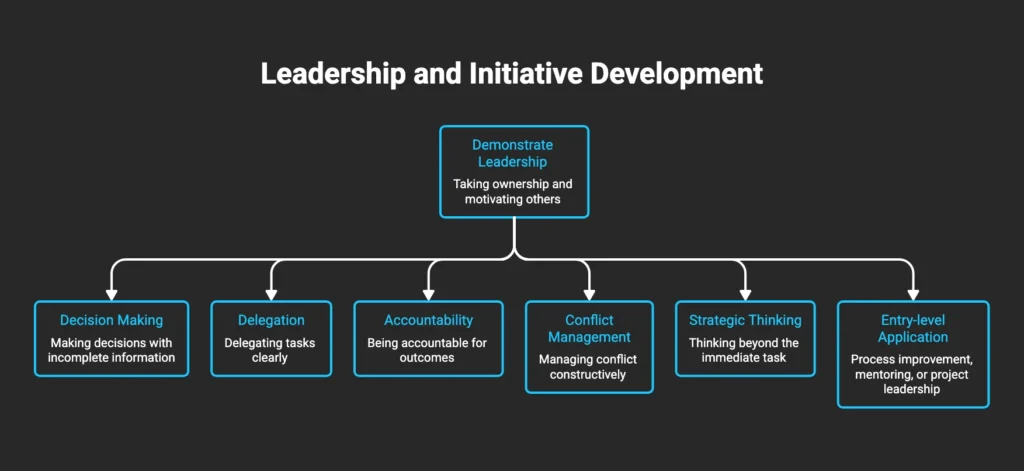
Leadership is not limited to people with “Manager” in their title. Employers value professionals who take ownership, spot problems early, and motivate others when needed.
In the WEF report, leadership and social influence is one of the top five core skills employers identified. In practice this includes:
- Making decisions with incomplete information
- Delegating clearly
- Being accountable for outcomes
- Managing conflict constructively
- Thinking beyond the immediate task
Entry-level professionals can show leadership too, by owning a process improvement, mentoring a new starter, or volunteering to lead a small project.
How to show it: Look for moments where you took responsibility without being asked, and describe the outcome.
7. Digital and Technology Skills
The WEF report ranks AI and big data, networks and cybersecurity, and technological literacy as the top three fastest-growing skills. Employers do not expect everyone to become a specialist. They do expect confidence with digital tools relevant to the role, such as productivity software, collaboration platforms, data tools, industry-specific systems, and increasingly, AI assistants.
A realistic standard is this: you can learn new tools quickly, use them responsibly, and check their output. Treat AI-generated material as a draft, because you remain accountable for what you submit.
How to show it: Name the tools you use and what you do with them. “Built a reporting dashboard that cut monthly reporting time” says more than “proficient in Excel.”
8. Emotional Intelligence
Technical knowledge can get you through the door, but emotional intelligence affects how well you work once inside. It covers understanding your own reactions and responding well to other people’s.
It matters most under pressure: delivering difficult feedback, handling an unhappy client, working with a stressed team, or recovering after a mistake. The WEF report lists motivation and self-awareness among the top five core skills employers want.
Employers rarely test this directly. They notice it in how you describe past conflicts. Candidates who blame others tend to stand out for the wrong reasons, while candidates who explain what they learned stand out for the right ones.
How to show it: When describing a difficult situation, include what the other person needed and how you adjusted.
9. Time Management and Reliability
Professionals are expected to manage several responsibilities at once. Employers want people they can trust to prioritise well, meet deadlines, and flag problems before they become crises, without constant supervision.
Good time management is visible in small habits: realistic estimates, clear status updates, and saying “I need more time, and here is why” early instead of late. Reliability, doing what you said you would do, is often what separates a good colleague from a great one.
How to show it: Use numbers where you can. “Managed 12 client accounts and delivered all quarterly reports on schedule” is concrete and checkable.
10. Critical Thinking and Sound Judgement
Critical thinking and analytical thinking overlap, but the emphasis differs. Analysis breaks a problem down. Critical thinking questions the information you are given: Where did this data come from? What is missing? What could go wrong?
This is increasingly important as AI tools, dashboards, and online sources produce information faster than anyone can verify it. Employers in finance, management, research, technology, and compliance value people who ask good questions and identify risks before acting.
How to show it: Share an example where you questioned an assumption and the outcome improved, such as spotting an error in a report or challenging an unrealistic plan.
11. Professional Ethics and Integrity
Qualifications show what you know, and integrity shows whether you can be trusted with it. Many certification bodies require members to follow a code of conduct, and employers know that standards matter most when they are inconvenient.
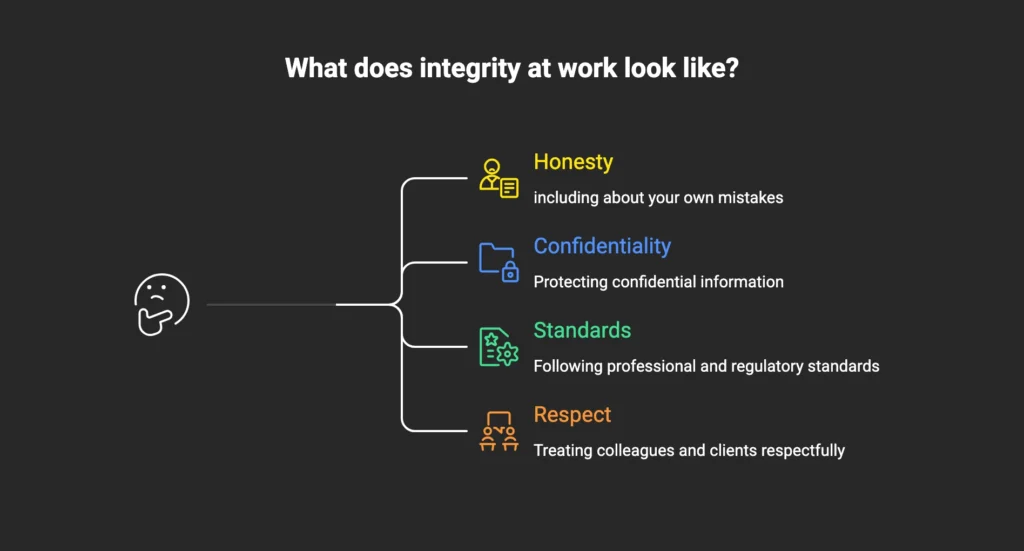
Integrity at work looks like:
- Being honest, including about your own mistakes
- Protecting confidential information
- Following professional and regulatory standards
- Treating colleagues and clients respectfully
A reputation for integrity takes years to build and can be lost in one decision. Employers screen for it through references, background checks, and interview questions about ethical dilemmas.
How to show it: Be willing to discuss a time you made a mistake and how you handled it. Employers generally trust candidates who can own an error more than candidates who claim to have none.
12. Continuous Learning
One qualification may help you enter a profession, but continued learning keeps you relevant. With nearly four in ten core skills expected to change by 2030, employers value people who invest in their own development.
That can include renewing certifications, taking short courses, attending industry events, completing continuing professional development (CPD) hours, and learning independently. What matters is that the learning is deliberate and connected to your work.
How to show it: Keep a simple record of what you have learned each year and how you applied it. It makes CV updates and appraisal conversations much easier.
Certification vs. Skills: How Employers Actually Weigh Them
Employers rarely treat these as competing. A certification gives them a quick, standardised signal that you have studied a subject to a recognised level. Skills give them evidence that you can perform.
For a hiring manager, a certification can reduce uncertainty at the shortlisting stage, and demonstrated skills settle the decision at interview. A certification with no evidence of application leaves questions open, and strong skills with no formal credential can leave gaps in some regulated or technical fields. The strongest candidates have both and can connect them.
How Certified Professionals Can Stand Out
Many CVs simply list credentials. Recruiters scanning dozens of applications get more from a line that shows application and result.
Instead of:
Certified in Project Management
Try:
Applied project management methods to coordinate a cross-functional project across three departments, delivering two weeks ahead of schedule and reducing rework.
Use the same approach in your LinkedIn profile and in interviews:
- Replace responsibilities with achievements wherever possible
- Add numbers, even approximate ones, such as time saved, costs reduced, or people supported
- Link each certification to a real example of use
- Mention tools, methods, and standards by name
- Keep claims accurate, because interviewers will ask about them
NACE’s guidance for job seekers reflects this: highlighting specific examples of these skills on a resume helps candidates reach the interview stage.
The details you add are what make your qualifications credible to a reader who has never worked with you.
Leave a Reply