
1. Introduction: Balancing Local Compliance with International Expectations
Training providers operate in an increasingly demanding educational environment. They must satisfy national regulatory requirements while also responding to the expectations of international partners, employers, learners and other stakeholders. Managing both sets of expectations can become challenging, particularly when institutions maintain separate quality assurance processes for local compliance and international accreditation.
National regulations establish the legal requirements for operating an educational or vocational training institution. These may include institutional licensing, programme approval, trainer qualifications, infrastructure and alignment with national qualifications frameworks. International quality benchmarks, meanwhile, provide additional reference points for evaluating institutional practices, educational delivery and continuous improvement.
When these requirements are managed independently, institutions may face duplicated documentation, repeated audits, increased administrative costs and uncertainty about which requirements take priority. A hybrid quality model offers a more coordinated approach by bringing relevant national and international requirements into one quality assurance framework.
The objective is not to replace local regulations or treat all international standards as equivalent. Instead, training providers can build on their statutory obligations while integrating suitable international quality practices into their existing systems. This can support operational efficiency, consistent quality management and stronger institutional credibility.
2. Two Worlds of Quality: Local Compliance vs. International Benchmarks
Local compliance and international quality benchmarks serve different but complementary purposes. Understanding their scope is the first step towards developing an integrated quality system.
Local compliance: Meeting national regulatory requirements
Local compliance refers to the legal and regulatory obligations that educational institutions must meet in the countries where they operate. These requirements vary according to the national education system, regulatory authority and type of institution.
Common areas include:
- Institutional registration, licensing and approval.
- Alignment of programmes with the National Qualifications Framework (NQF), where applicable.
- Approved curricula and programme delivery requirements.
- Trainer qualifications and professional competency.
- Infrastructure, facilities and learning resources.
- Student admission, assessment and record management.
- Regulatory inspections, reporting and audit requirements.
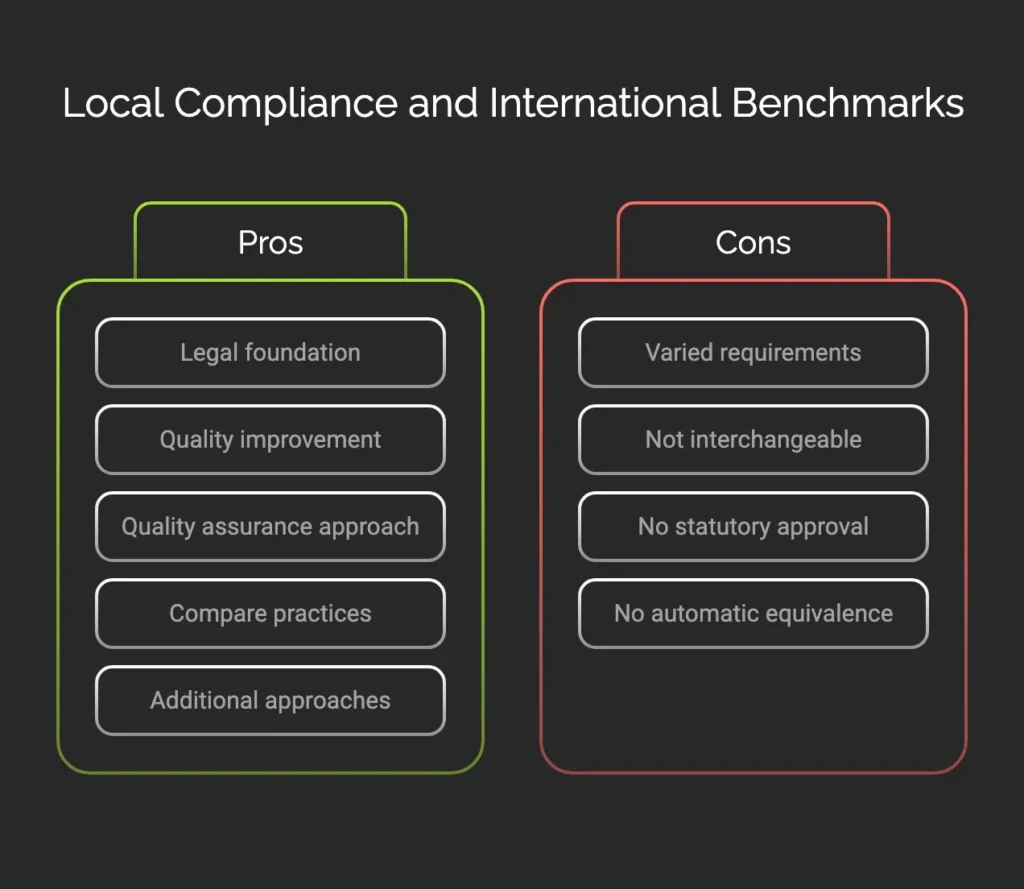
These requirements establish the institution’s legal foundation. Training providers must identify the relevant authorities and comply with the rules applicable to their programmes and operations.
International benchmarks: Strengthening quality practices
International benchmarks provide frameworks, standards and evaluation approaches that can help institutions improve their educational and organisational practices. Depending on their scope, they may focus on management systems, vocational education, higher education quality assurance or external evaluation.
Examples include:
- ISO 21001:2025: An international management system standard for educational organisations. It provides requirements for establishing and improving a management system that supports educational processes, learner satisfaction and organisational performance. It is not a substitute for statutory approval or a guarantee of institutional accreditation.
- EQAVET: The European Quality Assurance Reference Framework for Vocational Education and Training. It provides a quality assurance approach based on planning, implementation, evaluation and review, supported by indicators.
- ESG 2015: The Standards and Guidelines for Quality Assurance in the European Higher Education Area. They address internal and external quality assurance in higher education within the European Higher Education Area.
- INQAAHE International Standards and Guidelines (ISGs): These provide guidance primarily for quality assurance agencies and external quality assurance bodies.
These frameworks have different purposes and are not interchangeable. Their relevance depends on the institution’s educational sector, geographical context and quality objectives. Peer reviews and external evaluations may also provide opportunities to compare institutional practices with relevant quality expectations.
Qualification comparability is another important consideration. Institutions may need to demonstrate how their programmes, learning outcomes and assessment practices relate to recognised qualification frameworks. However, adopting an international benchmark or receiving accreditation does not automatically establish equivalence or guarantee recognition of qualifications in another country.
The key distinction is that local compliance determines whether an institution meets its applicable legal obligations, while international benchmarks can provide additional approaches for strengthening quality and demonstrating institutional commitment.
3. What Is a Hybrid Quality Model?
A hybrid quality model is an integrated quality assurance approach that combines mandatory national regulatory requirements with relevant international quality benchmarks within one institutional framework.
Instead of maintaining separate systems for local compliance and international accreditation, institutions identify common requirements and address them through shared policies, procedures, records and quality controls.
The model can be understood through two connected layers.
Layer 1: Local regulatory compliance
This layer establishes the mandatory foundation of the quality system. It covers the institution’s applicable licensing conditions, programme approvals, qualification framework requirements, trainer qualifications, infrastructure standards and regulatory reporting obligations.
Layer 2: International quality alignment
This layer incorporates relevant international quality practices that complement the local requirements. These may relate to educational management, learner satisfaction, programme evaluation, assessment quality, risk management, performance monitoring and continuous improvement.
Both layers operate through a shared quality assurance structure rather than separate administrative systems.
A successful hybrid model is based on four core principles.
Regulatory priority: National statutory requirements remain mandatory. International benchmarks can strengthen institutional practices but cannot replace local legal obligations.
Requirement alignment: Similar requirements should be mapped together so that common activities can be managed through shared processes and evidence.
Consistent documentation: Policies, procedures, records and audit trails should be organised within a coordinated documentation system.
Continuous improvement: Quality assurance should involve regular evaluation, corrective action and review rather than being limited to preparation for external audits.
The purpose of this approach is to create a unified quality framework that supports regulatory compliance while allowing institutions to improve their practices in line with relevant international expectations.
4. How to Build a Hybrid Quality Model
Implementing a hybrid quality model requires a structured process. Training providers should first understand their existing regulatory obligations, identify relevant international benchmarks and assess how their current quality systems address both.
Step 1: Identify applicable requirements
Begin by preparing a list of national regulatory requirements relevant to the institution. This should include licensing, programme approval, curriculum requirements, trainer qualifications, infrastructure, student assessment and reporting obligations.
Next, identify international standards or quality frameworks that are relevant to the institution’s sector and objectives. Their applicability should be evaluated carefully rather than adopting several frameworks without a clear purpose.
The institution should also distinguish between mandatory regulatory requirements, contractual obligations and voluntary quality benchmarks.
Step 2: Conduct a gap analysis
A gap analysis compares the institution’s existing policies, procedures and practices against the identified requirements.
The institution can prepare a requirement matrix with three main categories:
- Requirements common to local regulations and international benchmarks.
- Requirements specific to national regulatory authorities.
- Requirements introduced by the selected international benchmark.
For each requirement, the institution should record its current status, available evidence, identified gaps, responsible department and required corrective action.
Gaps can then be prioritised according to their regulatory risk, operational impact and implementation urgency. This helps management allocate resources to the areas that need attention first.
Step 3: Map requirements to shared quality controls
After completing the gap analysis, the institution should identify requirements that can be addressed through common processes.
For example, trainer qualification records may support national staffing requirements as well as international expectations relating to staff competency. Similarly, student assessment records, programme reviews and learner feedback may provide evidence for multiple quality requirements.
A mapping matrix can connect each requirement to the relevant institutional policy, procedure, responsible team and supporting evidence.
This reduces duplication while ensuring that each requirement is still addressed according to its specific conditions.
Step 4: Establish a unified quality assurance system
The next step is to bring the mapped requirements into one quality management structure.
This may include a central quality manual, standard operating procedures, institutional policies, performance indicators and clearly assigned responsibilities.
The quality manual should explain how the institution manages its regulatory obligations and international quality objectives. Departments should understand which procedures they follow, what records they maintain and how their work contributes to institutional quality.
Management should also establish a clear process for reviewing requirements when regulations or selected benchmarks change.
Step 5: Develop consistent documentation and audit trails
Maintaining separate documentation for different audits can increase administrative pressure and create inconsistencies.
A central digital repository can help institutions organise:
- Institutional policies and procedures.
- Programme approval and curriculum records.
- Trainer qualifications and competency records.
- Student admission and assessment documentation.
- Learner feedback and programme evaluation reports.
- Internal audit findings and corrective actions.
- Regulatory submissions and external evaluation records.
Each document should have clear ownership, version control and access permissions. Evidence should also be mapped to the requirements it supports.
An organised audit trail makes it easier to trace decisions, identify changes and demonstrate how quality requirements are being addressed.
Step 6: Integrate internal audits and external reviews
Internal audits should assess both regulatory compliance and the effectiveness of the institution’s quality processes.
Where local and international requirements overlap, audit activities can be coordinated to reduce repeated checks. However, the audit process must still address the specific evidence and evaluation criteria required by each relevant authority or framework.
External reviews and peer evaluations can also provide additional insight into institutional performance. Their findings should be considered alongside internal audit results and regulatory feedback.
Step 7: Establish continuous improvement processes
A hybrid quality model should be reviewed regularly to remain effective.
The Plan-Do-Check-Act (PDCA) cycle offers a practical approach:
- Plan: Identify quality objectives, requirements, risks and improvement priorities.
- Do: Implement the required policies, procedures and operational activities.
- Check: Monitor performance, review evidence and conduct internal evaluations.
- Act: Address gaps, implement corrective actions and update processes.
Management reviews should consider audit findings, learner feedback, programme performance, regulatory changes and resource requirements. This helps ensure that the quality framework remains relevant as institutional needs evolve.
5. Benefits and Trade-Offs of a Hybrid Quality Model
A well-designed hybrid quality model can offer several operational and strategic advantages. However, institutions should also understand the resources and implementation challenges involved.
Improved operational efficiency
Mapping overlapping requirements to shared policies and procedures can reduce repeated documentation and unnecessary administrative work. Centralised evidence systems also make it easier for departments to prepare for reviews and audits.
Stronger institutional credibility
Demonstrating compliance with national regulations alongside relevant international quality practices can help institutions communicate their commitment to quality. This may support engagement with international partners, employers and other stakeholders.
However, credibility depends on the relevance and credibility of the selected framework, the quality of implementation and the scope of any external recognition. International acceptance should never be assumed automatically.
Reduced duplication
A unified quality assurance system allows institutions to coordinate internal audits, evidence collection, programme reviews and corrective actions. This can reduce the burden of maintaining separate systems for different quality requirements.
Better management oversight
A shared framework provides management with a clearer view of institutional performance, compliance gaps, risks and improvement activities. It also encourages departments to work towards common quality objectives.
Resource requirements
Developing a hybrid model requires time, staff involvement, training, documentation and potentially digital quality management tools. Institutions may need external expertise to interpret unfamiliar regulatory requirements or international standards.
Implementation complexity
Different frameworks may use different terminology, evaluation criteria and reporting expectations. Mapping them into one system requires careful planning. Staff may also resist changes to established processes, particularly when responsibilities are not clearly communicated.
Ongoing maintenance
A hybrid framework is not a one-time implementation exercise. Regulatory changes, updated standards, new programmes and changes in educational delivery may require regular reviews. Without clear ownership and management support, the system can become difficult to maintain.
The most effective approach is to select only relevant benchmarks, prioritise mandatory requirements and integrate processes wherever practical. The aim should be to simplify quality management rather than create another layer of administration.
6. Practical Example: Aligning Local and International Quality Requirements
Consider a hypothetical vocational training provider called Apex Institute of Technical Skills. The institution delivers technical training programmes and must meet the regulatory requirements of its country. It also wants to strengthen its quality practices to respond to the expectations of international partners.
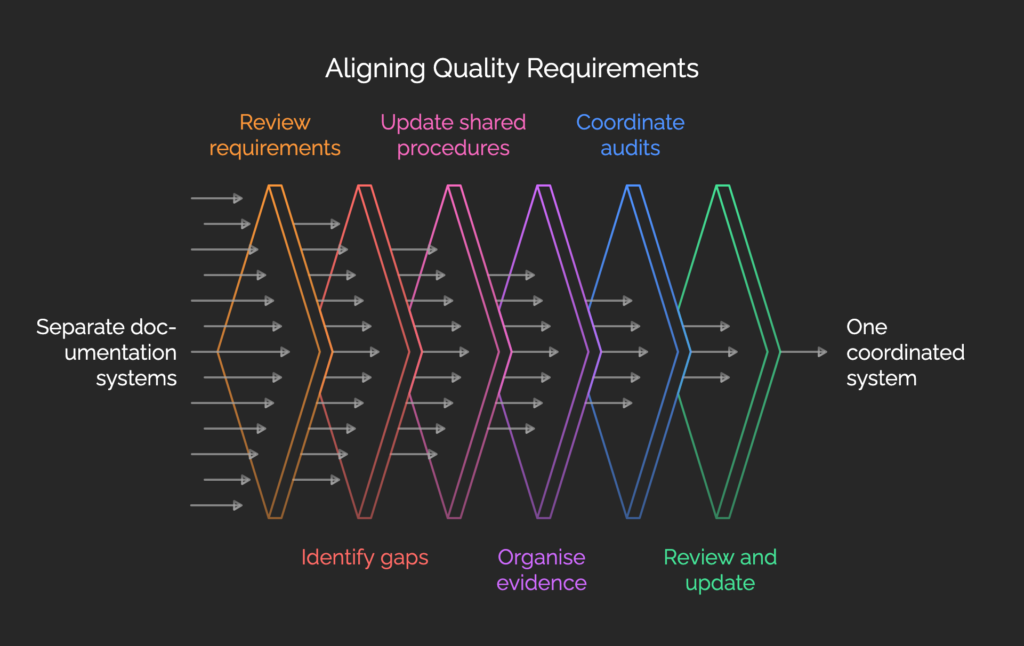
Initially, the institution manages national compliance and international quality requirements through separate documentation systems. Trainer records, programme evaluations, student assessments and internal audit reports are maintained in different formats. This creates repeated work and makes it difficult for management to obtain a consistent view of institutional performance.
To address the issue, Apex decides to introduce a hybrid quality model.
The first step is to review its national regulatory obligations, including institutional approval, programme requirements, trainer qualifications and student assessment procedures. Management then selects an appropriate international quality benchmark based on the institution’s objectives and educational context.
A gap analysis identifies areas where existing procedures already satisfy both sets of requirements and areas where improvements are needed.
For example, the institution finds that its trainer records already contain qualification details but do not consistently document professional development activities. It updates the existing trainer management procedure to include both the records required for local compliance and the additional information needed to monitor staff development.
Similarly, the institution uses one programme review procedure to evaluate curriculum delivery, student feedback, assessment outcomes and improvement actions. The relevant evidence is organised in a central repository and mapped to the requirements it supports.
Apex also coordinates its internal audit schedule so that overlapping requirements can be reviewed together. Audit findings are recorded in a common corrective action register, with responsibility and completion dates assigned to the relevant departments.
Management periodically reviews the results and updates the system when regulatory or quality requirements change.
Through this approach, Apex can maintain its national compliance obligations while incorporating relevant international quality practices into one coordinated system. The example demonstrates how shared procedures and evidence can reduce duplication without treating different regulatory and quality frameworks as identical.
For institutions considering external accreditation support, the Central Board of Education Canada (CBEC) describes services including institutional accreditation, curriculum framework support, competency assessment, trainer recognition, student certification and qualification verification. Its published accreditation process includes institutional review and evaluation of academic and operational practices. These services may be considered as part of an institution’s wider quality development strategy. However, external accreditation services should be evaluated according to their stated scope and should not be treated as a replacement for statutory approval or as automatic evidence of international qualification equivalence.
Creating a Unified Quality Framework
A hybrid quality model offers training providers a structured way to manage national regulatory obligations while aligning their institutional practices with relevant international quality benchmarks.
The most important starting point is to understand the distinction between mandatory local requirements and voluntary international frameworks. Institutions should identify their regulatory obligations first and then select international benchmarks that are appropriate to their educational sector and objectives.
A structured gap analysis helps identify overlapping requirements, existing strengths and areas requiring improvement. Mapping these requirements to shared policies, procedures, documentation systems and quality controls can reduce duplication and make institutional quality management more consistent.
Centralised evidence, coordinated internal audits and regular management reviews further support the effectiveness of the framework. Continuous improvement should remain an ongoing responsibility rather than an activity undertaken only before an accreditation or regulatory review.
Institutions should also consider the resources, staff training and maintenance required to implement the model successfully. International benchmarks can strengthen quality practices and support institutional credibility, but they do not automatically replace national approvals or guarantee recognition of qualifications across borders.
Ultimately, a successful hybrid quality model is not about maintaining more standards or producing more documentation. It is about creating one coordinated quality assurance system that meets local obligations, supports relevant international expectations and encourages continuous improvement in education and training.
Contact CBEC Canada for more detailed guidance on institutional accreditation, curriculum framework support, trainer recognition and qualification verification. Our team can help you understand which services fit your institution’s goals, while keeping your national regulatory requirements as the priority.
Leave a Reply