
Introduction: Bridging the Gap Between Training and Industry Needs
Vocational education plays an important role in preparing people for employment by developing the practical knowledge and technical abilities required in specific occupations. However, completing a training programme does not always mean that a learner is ready to meet the expectations of an employer. The difference between what training providers teach and what businesses require is one of the central challenges in workforce development.
This skills gap often becomes visible when graduates enter the workplace. A learner may understand the theory behind a technical process but struggle to use industry equipment, follow workplace procedures, troubleshoot problems or work with professional software. For example, an IT graduate may understand networking principles but have limited experience handling support tickets, diagnosing live network issues or managing cloud-based systems. Employers must then invest additional time in workplace training before the new employee can work independently.
Industry-aligned vocational pathways help address this disconnect. They connect labour market demand, employer expectations, curriculum development, practical learning and competency-based assessment. Rather than designing courses around theory alone, training centres can develop programmes around the knowledge, skills and behaviours required for specific job roles.
Why the Skills Gap Persists in Vocational Education
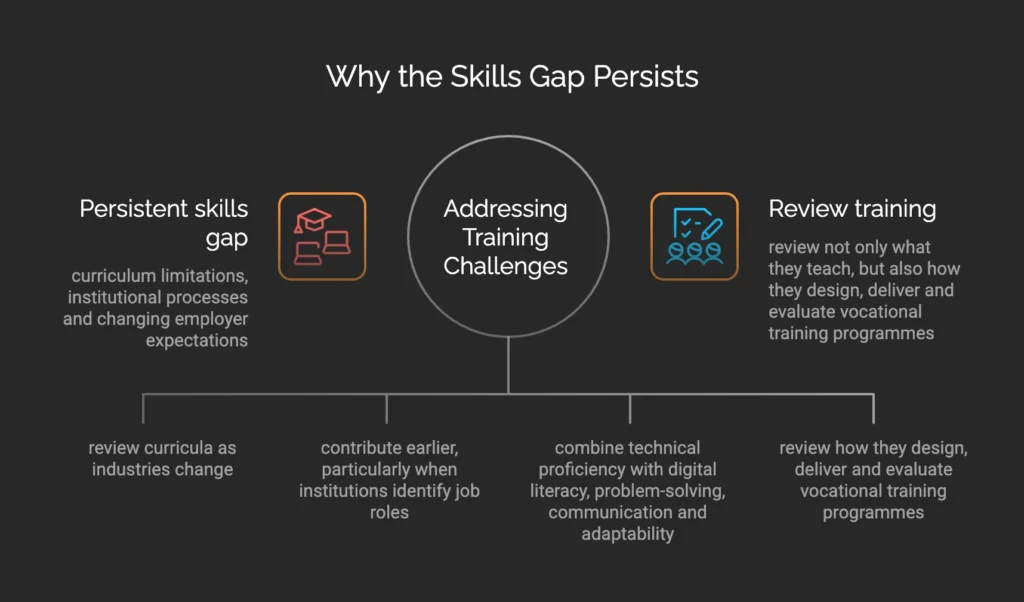
The skills gap does not arise from a single issue. It often reflects a combination of curriculum limitations, institutional processes and changing employer expectations.
Outdated curricula and slow review cycles
Industries change continuously as new technologies, equipment, regulations and working methods emerge. A curriculum that was relevant several years ago may no longer reflect the tasks employees perform today. Developments in artificial intelligence, cybersecurity, cloud computing, advanced manufacturing and renewable energy are examples of areas where occupational requirements can evolve quickly.
However, training providers may follow lengthy approval and review processes. This can delay the introduction of new content and leave learners practising skills that are no longer widely used.
Limited employer involvement
Some training centres consult employers only when learners are approaching graduation or looking for placements. While recruitment partnerships are useful, they do not address the full problem. Employers need opportunities to contribute earlier, particularly when institutions identify job roles, define competencies and develop course content.
Without this involvement, programmes risk reflecting what institutions believe employers need rather than what employers actually expect.
Changing workforce demands
Employers increasingly need workers who can combine technical proficiency with digital literacy, problem-solving, communication and adaptability. Even traditional occupations may require familiarity with digital systems, automated equipment and updated safety procedures.
A programme that focuses exclusively on a narrow technical task may therefore leave graduates unprepared for the wider responsibilities of a role.
Practical delivery constraints
Modern vocational training can require specialist equipment, updated software, suitable workshop facilities and instructors with current industry experience. These resources can be expensive to maintain. Where access is limited, learners may receive more classroom instruction than practical experience.
Addressing these challenges requires training centres to review not only what they teach, but also how they design, deliver and evaluate vocational training programmes.
Step-by-Step: Building Industry-Aligned Vocational Pathways
A structured approach helps training providers turn workforce requirements into practical learning programmes. The following stages provide an operational framework.
Step 1: Identify Labour Market Demand
Before developing a course, training centres should establish whether the relevant skills are needed in the target employment market. Course selection should be guided by evidence rather than assumptions about which occupations are popular.
Useful sources of information include:
- Labour market reports and occupational forecasts.
- Employer surveys and consultations.
- Job advertisements and recruitment trends.
- Industry association and sector reports.
- Regional workforce development strategies.
- Feedback from recruitment agencies and employment partners.
The research should identify the occupations experiencing demand, the qualifications commonly requested and the technical and transferable skills associated with those roles.
Local context is particularly important. The skills required for a healthcare support role, for example, may differ depending on the country’s regulations, workplace practices and professional requirements. Training providers should therefore distinguish between general occupational competencies and requirements specific to a region or employer.
The outcome of this stage should be a documented list of priority job roles, their expected competencies and the evidence supporting the decision to develop each programme.
Step 2: Build Active Employer Partnerships
Once priority occupations have been identified, training centres should involve employers in programme design. Effective employer partnerships go beyond signing agreements or inviting industry representatives to occasional events.
A structured employer advisory panel can provide regular input from businesses, industry associations, technical specialists and relevant professional bodies. Its responsibilities may include reviewing proposed course content, identifying emerging skills, evaluating training equipment and advising on workplace expectations.
Employers can contribute through:
- Reviewing job-role descriptions and required competencies.
- Participating in curriculum consultations.
- Providing demonstrations or guest lectures.
- Offering workplace visits and practical learning opportunities.
- Advising on equipment, software and safety requirements.
- Providing feedback on graduate performance.
Collaborative curriculum development helps ensure that the programme reflects actual workplace tasks. It also gives employers an opportunity to identify gaps before learners complete their training.
Partnerships should have clear responsibilities and measurable contributions. For example, an employer agreement could specify how often the organisation will review the curriculum, whether it will provide workplace mentors and how it will support practical learning. This makes the relationship more meaningful than a general statement of cooperation.
Step 3: Map Job Roles to Competencies
After identifying industry requirements, training providers need to translate them into clear learning outcomes. This is where competency mapping becomes essential.
A job title alone does not explain everything a learner must be able to do. Training centres should examine the tasks associated with the role and break them down into observable competencies.
For example, an IT support technician may need to demonstrate the ability to:
- Identify and diagnose common hardware and software issues.
- Configure basic network connections.
- Record and manage support requests.
- Apply cybersecurity and data protection procedures.
- Communicate technical information clearly to users.
Each competency can then be connected to a learning activity and an assessment method. A learner might study troubleshooting principles, practise diagnosing faults in a simulated environment and demonstrate the process through a practical assessment.
A competency map can use a simple structure:
| Job requirement | Competency | Learning activity | Assessment |
| Diagnose technical faults | Identify and resolve common system issues | Practical troubleshooting exercises | Demonstration using a test system |
| Manage support requests | Record, prioritise and respond to tickets | Ticketing system exercises | Completed support-ticket task |
| Follow security procedures | Apply basic cybersecurity practices | Guided security scenarios | Practical security checklist |
This approach makes the relationship between employment requirements and course outcomes visible. It also helps instructors identify missing content and ensures that assessment measures the skills the programme claims to develop.
Where relevant, providers can use recognised occupational or qualification frameworks to support consistency. However, they should verify the framework’s applicability and avoid presenting one country’s standards as universally recognised.
Step 4: Integrate Work-Based and Practical Learning
Technical knowledge becomes more meaningful when learners have opportunities to apply it. Work-based learning allows students to experience the responsibilities, routines and expectations of a real workplace.
Training centres can introduce practical exposure through several methods.
Apprenticeships and internships
These provide structured opportunities to learn in an employment setting. Learners can observe experienced professionals, perform supervised tasks and understand how theoretical concepts are applied in daily operations. The learning objectives, supervision arrangements and responsibilities should be agreed in advance.
On-the-job training
Where suitable employer partnerships exist, learners can develop competencies through supervised workplace activities. Training providers should ensure that the tasks relate to the curriculum and that learners receive appropriate guidance and feedback.
Workplace simulations and practical projects
Not every institution can provide immediate access to a real workplace. Simulated environments can help bridge this gap. For example, learners in healthcare support programmes can practise procedures in training environments, while students in IT can work with simulated networks and technical support scenarios.
Practical projects can also reproduce realistic workplace challenges. Learners might prepare a technical report, troubleshoot a system, complete a customer-service scenario or operate equipment under specified safety conditions.
Digital learning and simulation tools
Virtual reality, augmented reality and digital simulations may support learning where equipment is costly, access is limited or certain tasks involve safety risks. These tools should complement practical instruction rather than replace essential supervised experience.
The appropriate balance between theory and practical learning depends on the occupation, qualification requirements and level of risk involved. There is no single practical-to-theory ratio that should automatically be applied to every vocational programme.
Step 5: Assess Workplace Readiness Through Practical Demonstration
Written examinations can measure knowledge, but they do not always establish whether a learner can perform a job-related task. Industry-aligned vocational pathways should therefore include assessments that reflect actual workplace responsibilities.
A practical assessment might require a learner to operate equipment, complete a technical procedure, resolve a simulated problem or communicate with a customer in a realistic scenario.
Assessment criteria should be established before the task is performed. They may cover:
- Accuracy and quality of task completion.
- Correct use of tools and equipment.
- Compliance with safety procedures.
- Ability to follow instructions and solve problems.
- Communication and professional conduct.
- Consistency and independence of performance.
Portfolios, project submissions, supervisor observations and practical demonstrations can provide additional evidence of competency. Where applicable, independent assessment or recognised awarding-body requirements can strengthen the credibility of the process.
Training providers should also ensure that certificates accurately describe the qualification or achievement awarded. Employers need a reliable way to understand what a credential represents. Digital verification systems can support authenticity checks, but verification alone does not establish that a qualification is a professional licence or is recognised by every employer or regulator.
Keeping Vocational Training Pathways Current and Relevant
Industry alignment is not a one-time activity. A programme that meets employer needs today may require changes as technology, regulations and occupational responsibilities evolve.
Establish regular curriculum reviews
Training centres should create a formal review schedule rather than waiting until a programme becomes outdated. Reviews can involve instructors, employers, graduates and relevant industry representatives.
The review should examine whether course content still reflects current workplace tasks, whether equipment and software remain relevant and whether assessment methods measure the required competencies.
Use employer and graduate feedback
Feedback is most useful when it leads to specific improvements. Employers can report which skills new employees perform well and where additional training is required. Graduates can explain whether their training prepared them for actual workplace responsibilities.
Institutions can collect this information through employer surveys, graduate interviews, placement-supervisor feedback and follow-up discussions.
For example, if employers repeatedly report that graduates struggle with technical documentation, the training centre can introduce more report-writing exercises and include documentation quality in practical assessments.
Track outcomes beyond course completion
Completion rates alone provide an incomplete picture of programme effectiveness. Training centres should also examine employment outcomes, job retention, employer satisfaction and opportunities for further development.
A six-month graduate follow-up can be one useful method, although the appropriate tracking period will depend on the course and employment sector. The information should be used to identify patterns and improve future programme delivery.
Support continuous upskilling
Vocational education should not be limited to initial training. Short courses, additional modules and relevant micro-credentials can help workers update their skills as occupational requirements change.
Instructors also need opportunities to remain current. Industry placements, professional development, technical workshops and training on new equipment can help educators maintain relevant knowledge.
These practices create a continuous improvement cycle in which labour market information informs curriculum design, workplace performance informs assessment and feedback guides future updates.
Common Pitfalls to Avoid When Designing Vocational Pathways
Even well-intentioned programmes can fail to achieve industry alignment if important design issues are overlooked.
Superficial employer partnerships
An agreement with an employer does not automatically create a meaningful partnership. If businesses do not contribute to curriculum reviews, practical learning or feedback, their involvement may have little effect on programme quality.
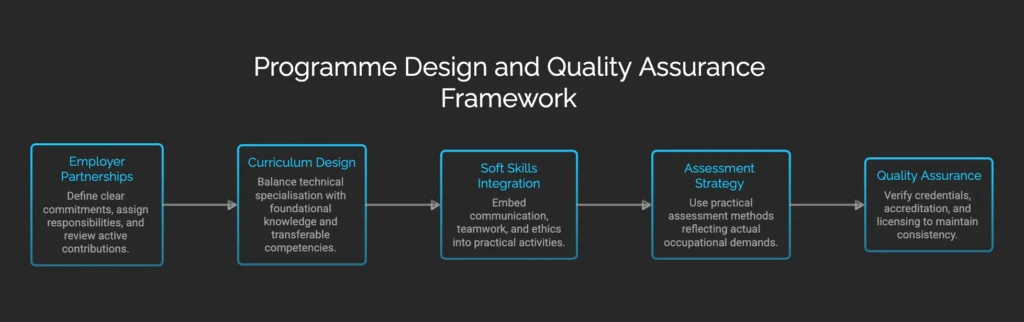
Training centres should define clear commitments, assign responsibilities and review whether partners are actively contributing.
Excessive specialisation
Training learners for one specific software product, machine or narrow task can create short-term relevance but limit their ability to adapt. Technical modules should be supported by foundational knowledge and transferable competencies that remain useful when tools and processes change.
Neglecting soft skills
Technical ability is only one part of workplace readiness. Communication, teamwork, time management, problem-solving, workplace ethics and safety awareness influence how effectively employees perform their responsibilities.
These skills should be integrated into practical activities rather than treated as unrelated topics at the end of a programme.
Relying only on classroom assessments
A learner may perform well in written examinations without being able to complete a practical task independently. Training providers should use assessment methods that reflect the actual demands of the occupation.
Overlooking quality assurance and credential recognition
Institutions should understand the difference between internal certificates, externally assessed qualifications, institutional accreditation and professional licensing. They should verify the recognition and relevance of any framework or awarding body before making claims about a programme’s status.
Clear quality assurance processes help institutions maintain consistency, communicate the value of their credentials and build confidence among learners and employers.
Key Takeaways: Building Effective Vocational Pathways
Building industry-aligned vocational pathways requires a planned and continuous approach. Training centres can strengthen their programmes by following these principles:
- Start with verified demand: Use labour market research, employer surveys and workforce trends to identify relevant occupations and skills.
- Involve employers early: Make businesses active contributors to curriculum development, practical learning and programme reviews.
- Map competencies clearly: Connect job requirements with learning outcomes, training activities and measurable assessments.
- Prioritise practical experience: Use apprenticeships, internships, supervised workplace activities, simulations and realistic projects where appropriate.
- Assess actual performance: Evaluate whether learners can demonstrate the technical and transferable skills required by the role.
- Review and improve regularly: Use employer feedback, graduate outcomes and industry developments to update programmes.
- Maintain credible quality assurance: Ensure that qualifications, accreditation claims and credential-verification processes are clearly understood.
- Develop the whole professional: Combine technical proficiency with communication, adaptability, teamwork and workplace responsibility.
For vocational training centres, industry alignment is not simply about adding more practical sessions or introducing new courses. It is about creating a direct connection between what employers need, what institutions teach and what learners can demonstrate.
Educational institutions and vocational training providers looking to strengthen their academic quality and institutional credibility can explore the services offered by the Central Board of Education Canada (CBEC). Its services include institutional accreditation, curriculum framework support, competency assessment, student certification, certified trainer recognition and qualification verification. Through these services, CBEC supports institutions in developing structured educational programmes, maintaining quality-oriented practices and providing verifiable credentials. Training providers can explore the applicable accreditation and certification processes to understand how these services may support their institutional development and educational objectives.
Ultimately, effective vocational pathways are built through collaboration, measurable competencies and continuous improvement. When training providers and employers share responsibility for developing relevant skills, learners are better prepared to move from education into meaningful work.
Leave a Reply