
In this article
- Why credential status and privacy both matter?
- What is credential lifecycle management?
- Why real-time credential status tracking matters
- The privacy challenge in digital credential verification
- How to balance live status tracking with learner data privacy
- What an employer should check
- Practical checklist for training centres and awarding bodies
- Frequently asked questions
- Key takeaways
1. Why Credential Status and Privacy Both Matter
Digital credentials have become an important way for training providers, awarding bodies and educational institutions to recognise learning and professional competence. They allow learners to demonstrate their qualifications, while employers and other authorised parties can verify whether those credentials are genuine.
However, issuing a digital certificate is only one part of credential management. Organisations must also keep credentials accurate and trustworthy throughout their entire lifecycle. A credential that was valid when issued may later be renewed, suspended, revoked or expired. Without an effective status management process, employers may continue relying on credentials that are no longer valid.
Consider an employer recruiting a site safety inspector. The candidate presents a digital certificate that appears genuine, but the credential was revoked 30 days earlier because the holder no longer met the required conditions. If the employer checks only the original certificate, the outdated information could lead to an unsuitable appointment and potential workplace risks.
This is why digital credential verification must go beyond confirming that a document was issued by a recognised organisation. It must also establish whether the credential is currently valid.
At the same time, verification systems must protect learner information. Employers generally need to confirm the authenticity and current status of a qualification, not access the learner’s complete academic history or unrelated personal details. Training providers and awarding bodies must therefore balance reliable credential status tracking with responsible data management.
2. What Is Credential Lifecycle Management?
Credential lifecycle management is the set of processes used to create, maintain, update and manage a credential from its initial issuance until it is no longer valid. It ensures that credential information remains accurate and that changes in status can be recognised by authorised parties.
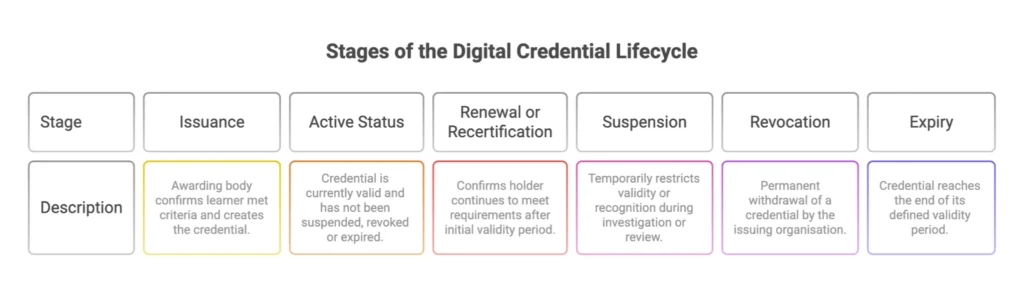
A typical digital credential lifecycle includes six stages.
Issuance
Issuance is the initial stage in which an awarding body or authorised institution confirms that a learner has met the required assessment or qualification criteria. The credential is created and issued with relevant information, such as the learner’s name, qualification, issuing organisation, issue date and applicable validity period.
The issuing organisation must ensure that the information is accurate and that the credential can be authenticated through an appropriate verification process.
Active Status
Once issued, a credential enters active status. This indicates that it is currently valid and has not been suspended, revoked or expired.
During this stage, employers and other authorised parties may need to verify the credential when assessing an individual’s qualifications. A reliable status management system should ensure that the information available to verifiers reflects relevant changes made by the issuing organisation.
Renewal or Recertification
Some credentials are valid only for a specified period or require holders to complete additional training, assessments or professional development activities. Renewal or recertification confirms that the holder continues to meet the applicable requirements.
The updated credential information should reflect the new validity period or certification status. Providers should also communicate renewal requirements clearly to avoid unnecessary lapses.
Suspension
Suspension temporarily restricts the validity or recognition of a credential. This may happen when an investigation is ongoing, required documentation is under review or the holder’s eligibility is being reassessed.
Unlike revocation, suspension does not necessarily mean that the credential has been permanently withdrawn. The system should communicate the current status accurately so that verifiers do not mistake a temporary restriction for a permanently cancelled credential.
Revocation
Revocation is the withdrawal of a credential by the issuing organisation. It may occur because of fraud, misrepresentation, an administrative error or failure to meet specified requirements.
Once revoked, the credential should no longer be presented as an active qualification. The issuing organisation must ensure that authorised verification processes reflect this change.
Expiry
Expiry occurs when a credential reaches the end of its defined validity period without being renewed. An expired credential may still be an authentic record of a qualification previously awarded, but it should not be represented as currently valid where ongoing validity is required.
The lifecycle at a glance
A simplified credential lifecycle can be represented as:
Issuance → Active Status → Renewal or Recertification → Suspension / Revocation / Expiry
Depending on the credential and the organisation’s policies, a suspended credential may later return to active status, while an expired credential may be renewed or recertified.
Suspension vs. revocation vs. expiry
These three end states are often confused. The table below summarises the differences.
| Suspension | Revocation | Expiry | |
| What it means | Temporary restriction of validity or recognition | Permanent withdrawal by the issuing organisation | Validity period has ended without renewal |
| Typical cause | Investigation, documentation review, eligibility reassessment | Fraud, misrepresentation, administrative error, unmet requirements | Reaching the end date without recertification |
| Can it be reversed? | Often, if the issue is resolved | Not normally | Yes, through renewal or recertification |
| Is the record still authentic? | Yes, but not currently recognised | Should not be presented as an active qualification | Yes, as a historical record of an award |
| What the verifier should see | “Suspended” (clearly distinct from revoked) | “Revoked” | “Expired”, with the original award still verifiable |
Managing these stages systematically helps organisations maintain accurate records and provide reliable verification information throughout a credential’s existence.
3. Why Real-Time Credential Status Tracking Matters
A digital credential can be authentic without being currently valid. This distinction makes credential status tracking an essential part of digital credential verification.
Traditional paper certificates and static digital documents usually display information as it existed when the document was issued. If a credential is subsequently suspended, revoked or expired, the original document may not automatically reflect the change. An employer relying only on the document could therefore make a decision using outdated information.
Real-time or regularly updated status tracking addresses this limitation by allowing authorised verifiers to check the current status of a credential against information maintained by the issuing organisation or its verification system.
Reducing credential fraud
Credential fraud can involve forged certificates, altered documents or the presentation of credentials that have been withdrawn. A reliable verification process helps employers distinguish between genuine credentials and documents that cannot be validated.
Checking current status also helps identify credentials that were once valid but are no longer active.
Supporting employer confidence
Employers often rely on qualifications when recruiting staff, assigning responsibilities and assessing professional competence. In sectors where specific qualifications matter for safety or regulatory purposes, outdated credential information can create additional risks.
Access to accurate status information helps employers make better-informed decisions without relying entirely on documents supplied by applicants.
Improving institutional accountability
Awarding bodies are responsible for maintaining the accuracy of the credentials they issue. A structured status management process allows them to record important changes, apply relevant policies and provide consistent verification information.
It also supports better coordination between issuing organisations and authorised verification channels.
Supporting verification requirements
Employers, educational institutions and other authorised organisations may need to confirm whether a qualification is genuine and currently valid. A dependable verification process makes this information easier to access while reducing the need for repeated manual checks.
However, real-time tracking should not mean unrestricted access to learner information. The objective is to provide accurate credential status information while limiting unnecessary data exposure.
4. The Privacy Challenge in Digital Credential Verification
Although digital verification improves access to credential information, it can also introduce privacy risks when systems collect or disclose more data than necessary.
A verification request may involve information such as the learner’s name, certificate number, qualification details, issuing institution and credential status. Depending on how the system is designed, it may also expose additional academic or personal information that is not relevant to the request.
Excessive personal information exposure
Employers generally need to confirm specific details, such as whether a qualification is genuine, who issued it and whether it remains valid. They do not necessarily need access to the learner’s complete academic records, contact information or unrelated personal details.
Displaying excessive information increases the risk of misuse, unauthorised sharing and unnecessary exposure of personal data.
Unrestricted access to verification systems
If verification platforms do not distinguish between different users and their responsibilities, sensitive information may become accessible to people who have no legitimate reason to view it.
For example, an employer verifying a qualification should not automatically receive the same level of access as an authorised administrator managing the issuing institution’s records.
Centralised data risks
Centralised verification platforms can store large amounts of credential and learner information. If access controls and security measures are inadequate, these platforms may become attractive targets for unauthorised access or data breaches.
Organisations must therefore consider how information is stored, protected and accessed.
The verification tracking concern
Another privacy challenge arises when a verification system contacts the issuing organisation’s server every time someone checks a credential. This process, sometimes described as a phone-home verification model, may allow the system operator to record when a credential is checked and potentially identify the organisation making the request.
If such information is retained without a clear purpose or appropriate safeguards, it may reveal details about a learner’s employment applications, professional activities or interactions with different organisations.
Verification systems must therefore consider not only what information is displayed but also what information is collected behind the scenes.
5. How to Balance Live Status Tracking with Learner Data Privacy
Training providers and awarding bodies need verification systems that maintain accurate credential status information without unnecessarily exposing learner data. This requires a combination of clear data governance policies, appropriate security controls and privacy-conscious technical design.
Apply data minimisation
Data minimisation means collecting, processing and sharing only the personal information necessary for a specific purpose.
For credential verification, this may involve allowing an employer to confirm the credential holder’s identity, qualification, issuing organisation and current status without providing access to the learner’s complete academic or personal record. Verification interfaces should be designed to display only the information required for the particular verification task.
Establish a clear purpose and lawful basis for processing
Organisations should define why learner information is collected, processed and shared. Credential data collected for issuing a qualification should not automatically be used for unrelated purposes.
Consent may be appropriate in certain verification arrangements, but it is not the only possible lawful basis for processing personal data. Organisations must identify and document the applicable lawful basis under the data protection requirements relevant to their activities and jurisdiction. Depending on where learners and verifiers are located, these may include frameworks such as the GDPR in the UK and EU or PIPEDA in Canada, along with any applicable regional or sector rules. Seek qualified legal advice for your specific situation.
Organisations should also explain how verification information is used and who may access it.
Introduce role-based access controls (RBAC)
Role-based access control restricts system access according to a user’s responsibilities.
For example, an employer may be permitted to verify a credential’s authenticity and current status, while an authorised institutional administrator may have additional permissions to update credential records.
This separation reduces the risk of unauthorised access and helps ensure that users can view only the information necessary for their roles. Strong authentication, including multi-factor authentication where appropriate, can provide an additional layer of protection.
Maintain secure audit logs
Audit logs record important activities within a credential management system, such as credential issuance, status changes, administrative updates and access to sensitive information. These records help organisations investigate suspicious activity, identify unauthorised access and establish accountability.
However, audit logs should also follow data minimisation and retention requirements. Recording every possible detail indefinitely can create additional privacy risks.
Define retention and deletion policies
Credential information and verification records should not be retained indefinitely without a valid reason. Organisations should establish retention periods based on legal obligations, operational requirements and legitimate recordkeeping needs.
They should also define procedures for securely deleting or anonymising information when it is no longer required, subject to applicable legal and regulatory obligations. Where information must be retained for audit, legal or qualification-record purposes, access should remain appropriately restricted.
Consider privacy-preserving verification methods
Modern digital credential technologies can help reduce the amount of personal information shared during verification.
Verifiable credentials. The W3C Verifiable Credentials Data Model provides a framework for representing credentials in a digitally verifiable format. Cryptographic proofs can help a verifier establish that credential information has not been altered and was issued by the relevant authority.
Selective disclosure. Selective disclosure allows a holder to share only the specific information required for a particular verification. For example, an employer may need confirmation of a qualification without requiring access to every detail contained in the original credential.
Status lists. The W3C Bitstring Status List specification provides a mechanism for publishing credential status information, including suspension or revocation status. Such mechanisms can support status checking without requiring the complete credential record to be publicly exposed. However, privacy depends on the overall system design, including how status information is requested, stored and accessed.
Zero-knowledge proofs. More advanced approaches, such as zero-knowledge proofs, can allow certain claims to be verified without revealing the underlying information. Their suitability depends on the use case, technical resources and implementation requirements.
These technologies do not automatically guarantee privacy. Organisations must assess how verification requests are handled, whether access patterns can be tracked and how status information is protected.
A real-world example: CBEC
For organisations developing credential verification processes, the Central Board of Certification and Education (CBEC) provides an example of institutional and student credential verification support. Its published processes include online verification portals, certificate reference numbers, QR code systems and official communication channels. Its data protection policy also describes safeguards for institutional and student information, including secure portal access, password-protected administrative platforms and controlled document access.
These published practices highlight the importance of combining accessible verification processes with responsible information handling.
6. What an Employer Should Check
When verifying a qualification, an employer or other authorised party should be able to answer four questions, and no more than these are normally needed:
- Is it genuine? Was the credential issued by the organisation it claims to come from, and has it been altered?
- Is it current? Is the status active, rather than suspended, revoked or expired?
- Who issued it, and for what? Which organisation awarded it, and for which qualification?
- Does it belong to this person? Does the holder’s identity match the credential?
A well-designed verification process answers these questions without exposing the learner’s wider academic or personal record.
7. Practical Checklist for Training Centres and Awarding Bodies
Managing credential status and learner privacy requires more than introducing a digital certificate platform. Training centres and awarding bodies should establish clear operational procedures and review them regularly.
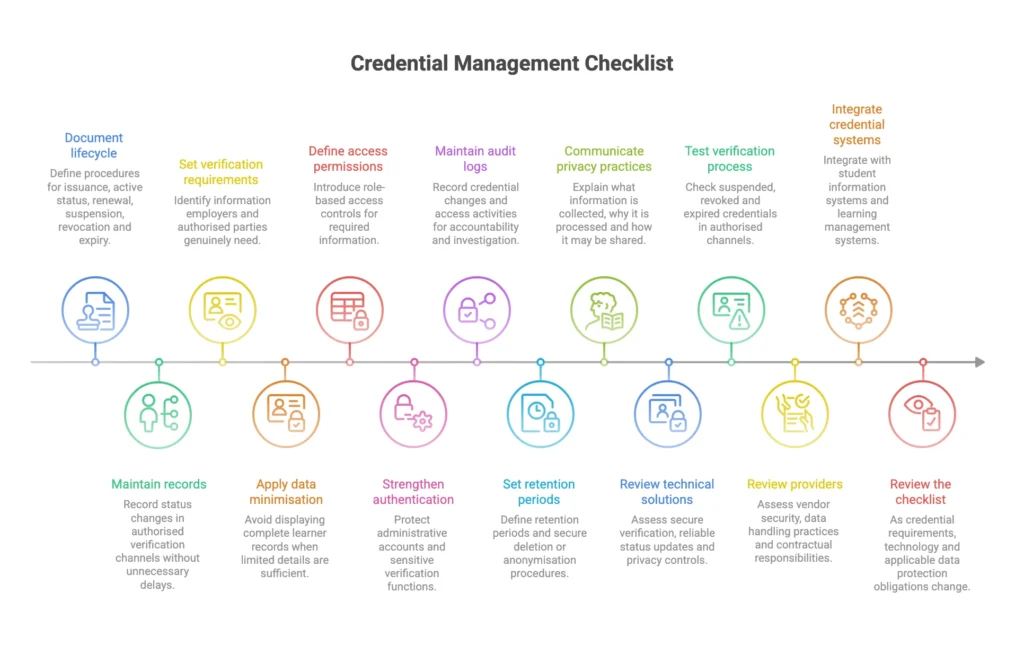
The following checklist can help organisations assess their credential management practices:
- Document the credential lifecycle: Define procedures for issuance, active status, renewal, suspension, revocation and expiry.
- Maintain accurate status records: Ensure that credential status changes are recorded and reflected in authorised verification channels without unnecessary delays.
- Establish verification requirements: Identify which information employers and other authorised parties genuinely need to verify a credential.
- Apply data minimisation: Avoid displaying complete learner records when a limited set of credential details is sufficient.
- Define access permissions: Introduce role-based access controls so that users can access only the information required for their responsibilities.
- Strengthen authentication: Use appropriate authentication measures to protect administrative accounts and sensitive verification functions.
- Maintain audit logs: Record important credential changes and access activities to support accountability and investigation.
- Set retention periods: Define how long credential information and verification records should be retained, and establish secure deletion or anonymisation procedures.
- Communicate privacy practices: Explain to learners what information is collected, why it is processed and how it may be shared during verification.
- Review technical solutions: Assess whether the chosen credential platform supports secure verification, reliable status updates and appropriate privacy controls.
- Test the verification process: Regularly check whether suspended, revoked and expired credentials are correctly identified by authorised verification channels.
- Review third-party providers: Assess the security, data handling practices and contractual responsibilities of vendors involved in credential storage or verification.
Organisations should also consider how their credential systems integrate with existing student information systems and learning management systems. Secure integration can reduce duplicate data entry and help maintain consistency across institutional records.
The checklist should be reviewed periodically as credential requirements, technology and applicable data protection obligations change.
8. Frequently Asked Questions
What is credential lifecycle management?
Credential lifecycle management is the set of processes used to create, maintain, update and manage a credential from issuance until it is no longer valid. It covers issuance, active status, renewal or recertification, suspension, revocation and expiry.
What is the difference between credential suspension, revocation and expiry?
Suspension is a temporary restriction, often pending a review or investigation. Revocation is a withdrawal of the credential by the issuing organisation. Expiry happens when the validity period ends without renewal. An expired credential can remain an authentic record of an earlier award, and it can often be renewed.
Can a digital credential be authentic but no longer valid?
Yes. A credential can be genuinely issued by a recognised organisation and still be suspended, revoked or expired. That is why verification should check current status, not just authenticity.
How can employers check a credential’s current status?
Employers can check status through channels maintained by the issuing organisation or its verification system, such as an online verification portal, a certificate reference number or a QR code. These checks should reflect the latest status recorded by the issuer.
What is a phone-home verification model, and why is it a privacy concern?
In a phone-home model, the verification system contacts the issuer’s server every time a credential is checked. If those requests are logged and retained without safeguards, they may reveal when a credential was checked and by which organisation, which can expose details about a learner’s job applications or activities.
What is selective disclosure in digital credentials?
Selective disclosure lets a holder share only the specific information a verifier needs, such as confirmation of a qualification, instead of every detail in the original credential.
What information should an employer see when verifying a qualification?
Generally, the holder’s identity, the qualification, the issuing organisation and the current status. Employers do not normally need the learner’s full academic record, contact details or unrelated personal information.
How long should training providers retain verification records?
There is no single answer. Retention periods should be based on legal obligations, operational needs and legitimate recordkeeping purposes, with secure deletion or anonymisation once information is no longer required.
9. Key Takeaways: Building Secure and Trustworthy Credential Systems
- Manage the whole lifecycle. Credential lifecycle management is essential for maintaining the accuracy and reliability of digital qualifications. A credential must be managed beyond its initial issuance, with procedures for active status, renewal, suspension, revocation and expiry.
- Track status, not just authenticity. Real-time or regularly updated credential status tracking helps employers and authorised parties identify credentials that are no longer valid. It also supports fraud prevention, institutional accountability and confidence in qualification verification.
- Protect learner privacy. Effective verification should not come at the cost of learner data privacy. Organisations must limit unnecessary personal information exposure, establish clear processing purposes, apply appropriate access controls and define responsible retention practices.
- Use privacy-preserving technology carefully. Verifiable credentials and selective disclosure can support more controlled verification, provided they are implemented with appropriate security and governance measures.
Ultimately, a trustworthy credential system must achieve two objectives: ensuring that qualifications can be reliably authenticated, and ensuring that the personal information behind those qualifications remains protected. By combining accurate lifecycle management with privacy-conscious verification, training providers and awarding bodies can build digital credential systems that serve the needs of learners, employers and institutions responsibly.
Leave a Reply