In today’s education and employment landscape, professional qualifications are increasingly shared and verified online. Degrees, certificates, diplomas, training credentials, and professional certifications are no longer limited to paper documents. As more organisations move towards digital credentials, the need for secure and reliable verification has grown with them.
This is where a digital verification portal can play an important role. A digital verification portal gives employers, educational institutions, professional organisations, and other authorised parties a way to confirm whether a credential is genuine. Instead of relying only on a printed certificate, a verifier can check the credential against an official digital record.
But how exactly does it work, and how can it help prevent credential fraud? Let’s take a closer look.
What Is a Digital Verification Portal?
A digital verification portal is an online system that allows authorised users to check the authenticity and status of a certificate or professional credential.
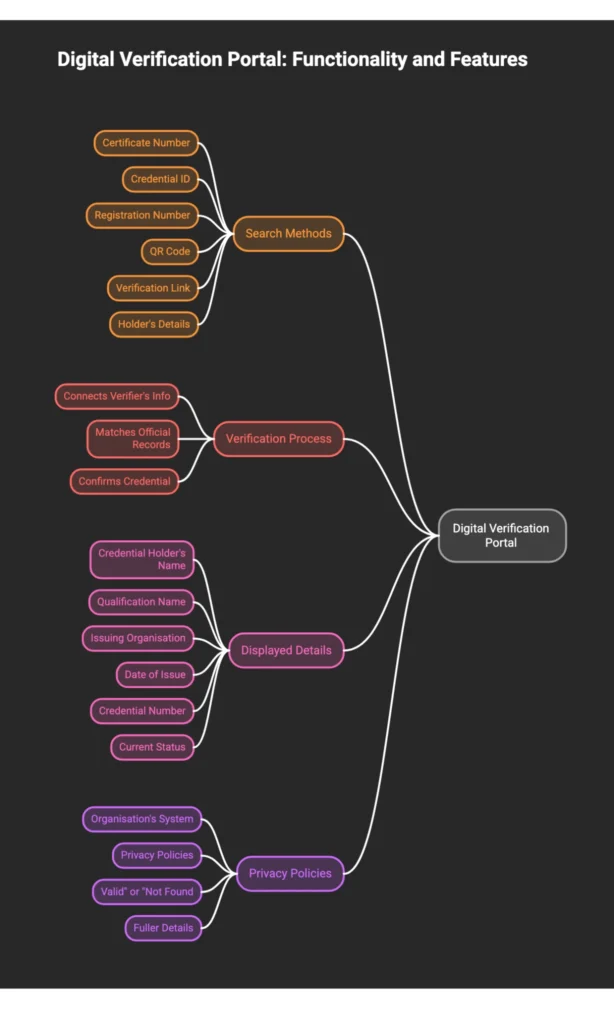
Depending on the system, a user may be able to search for a credential using:
- A certificate number
- A unique credential ID
- A registration number
- A QR code
- A secure verification link
- The credential holder’s details
The portal then connects the information provided by the verifier with the official records maintained by the organisation that issued the credential. If the information matches, the portal may display details confirming the credential. These details could include:
- The name of the credential holder
- The name of the qualification
- The issuing organisation
- The date of issue
- The credential number
- The current status
The information available will depend on the organisation’s verification system and its privacy policies. Some portals show only a simple “valid” or “not found” result, while others display fuller details.
Why Credential Fraud Is a Growing Concern
Credential fraud takes several forms. Some people create entirely fake certificates, sometimes from organisations that do not exist. Others alter a genuine certificate by changing a name, grade, or date. Some falsely claim a qualification they never completed, relying on the fact that few employers check.
Paper documents make all of these easier. A certificate can be scanned, edited, printed, and photocopied, and a convincing copy can be hard to distinguish from the original by eye alone. As hiring becomes more international, employers often review candidates from countries and institutions they have never dealt with, which makes manual checking even harder.
The result is a trust problem. Honest graduates have to compete with people who present false credentials, and employers lose confidence in certificates in general. A verification portal addresses the problem at its source, by giving everyone a reliable record to check against.
How Does a Digital Verification Portal Work?
Although different systems use different technologies, the basic process is usually straightforward.
Step 1: A credential is issued. A student or professional successfully completes the required programme, assessment, or certification process. The issuing organisation creates an official record of the credential.
Step 2: A unique identifier is created. The credential may receive a unique certificate number or digital credential ID. This identifier is connected to the official record.
Step 3: The credential is added to the verification system. The credential information is stored within the organisation’s secure database or digital credential platform.
Step 4: The credential holder shares the credential. The professional may share their certificate, digital credential, verification link, or QR code with an employer or institution.
Step 5: The credential is verified. The employer or institution visits the official verification portal and enters the required information or scans the QR code. The system checks the information against the official record.
Step 6: The verification result is displayed. If the information matches, the portal may confirm that the credential is valid. If there is a problem, the system may indicate that:
- The credential could not be found
- The information does not match
- The credential has expired
- The credential has been withdrawn
- The credential status cannot be confirmed
The exact result will depend on how the organisation has designed its verification system.
How Does a Digital Verification Portal Help Prevent Credential Fraud?
1. It makes fake certificates easier to detect
A fake certificate may look convincing on paper. However, if an employer checks the certificate number and the credential does not exist in the official database, the discrepancy can be identified quickly. This makes it more difficult for someone to present a completely fabricated qualification as genuine.
2. It helps identify altered certificates
Fraud does not always involve creating a certificate from scratch. Sometimes, a genuine certificate is altered. For example, someone might change the name, qualification title, date, grade, or certificate number.
A digital verification system provides an independent record against which the physical or digital certificate can be compared. If the details do not match the official record, the employer can investigate further.
3. It reduces reliance on paper documents
Paper certificates can be lost, damaged, forged, altered, or photocopied. A digital verification portal provides an additional source of evidence. Instead of relying entirely on the document presented by the candidate, the employer can check the issuing organisation’s official record. This can make the verification process more reliable.
4. It creates a clear verification trail
A well-designed digital credential system can maintain records of issued credentials and their status. This can help organisations track when a credential was issued, which credential was issued, whether the credential is active, and whether it has been withdrawn or revoked. Having a clear record can make it easier to identify inconsistencies and to respond when questions arise.
5. It makes verification faster
Traditional verification can involve emails, phone calls, and manual paperwork, and it can take days or even weeks. A digital verification portal can reduce the process to a few minutes.
For employers hiring internationally, this is especially useful. Instead of contacting multiple institutions individually, employers may be able to verify credentials online, whatever the time zone or language. Faster checks also mean that verification is more likely to happen at all, because it no longer feels like a burden.
What Happens If a Credential Is Revoked?
Some digital verification systems allow organisations to update the status of a credential. For example, a credential might be:
- Active
- Expired
- Suspended
- Withdrawn
- Revoked
This is particularly important for professional certifications that require ongoing renewal or continuing professional development. If a credential is no longer valid, the verification system may reflect its current status. This helps prevent someone from continuing to present an outdated or withdrawn credential as active.
A printed certificate cannot do this. Once it has been issued, the paper stays the same forever, even if the qualification behind it has lapsed. A live verification record, by contrast, can show the current position at the moment it is checked.
The Role of QR Codes in Credential Verification
QR codes are becoming increasingly common on certificates. A QR code can provide a quick way to access a verification page. For example, an employer can scan the code using a smartphone and be directed to the credential’s verification record.
However, a QR code by itself does not guarantee authenticity. A fraudulent certificate can also contain a QR code. The important question is: where does the QR code lead?
The verification page should ideally be connected to the legitimate issuing organisation or a trusted credential platform. Employers should always check the destination carefully before trusting the information provided. A simple habit is to look at the web address after scanning, confirm that it belongs to the issuer, and, if in doubt, visit the issuer’s official website directly and enter the certificate number there.
Digital Verification vs. Digital Credential
These terms are sometimes used interchangeably, but they are not exactly the same.
A digital credential is the digital representation of an achievement or qualification. A digital verification portal is the system that allows someone to confirm whether that credential is genuine.
- Digital credential: what the professional has earned
- Verification portal: how others confirm that it is genuine
The two systems can work together to create a more secure credential ecosystem. The credential carries the claim, and the portal supplies the evidence that the claim can be trusted.
Does Digital Verification Guarantee That a Qualification Is Recognised?
No, and this is an important distinction.
A digital verification portal can confirm that a credential was issued by a particular organisation. It does not automatically mean that the credential is:
- Government-recognised
- Accredited by a specific authority
- Equivalent to a university degree
- Accepted for professional licensing
- Recognised in every country
Verification confirms authenticity. Recognition depends on the requirements of the relevant employer, institution, professional body, regulator, or government authority.
Employers should therefore ask two separate questions. First, is the credential genuine? Second, is this credential appropriate or recognised for the purpose for which it is being presented? A certificate can be perfectly genuine and still not meet the requirements of a particular role or profession.
What Makes a Good Digital Verification Portal?
Not all verification systems are equally effective. A reliable portal should ideally provide:
- Secure access. The system should protect credential records against unauthorised changes.
- Unique credential identification. Each credential should have a unique identifier.
- Accurate records. The information displayed should match the official records.
- Easy verification. Employers should be able to verify credentials without unnecessary complexity.
- Current status information. Where applicable, the portal should show whether the credential is active, expired, suspended, or revoked.
- Clear issuer information. The portal should clearly identify the organisation responsible for issuing the credential.
- Data protection. Personal information should be handled responsibly and in accordance with applicable privacy requirements.
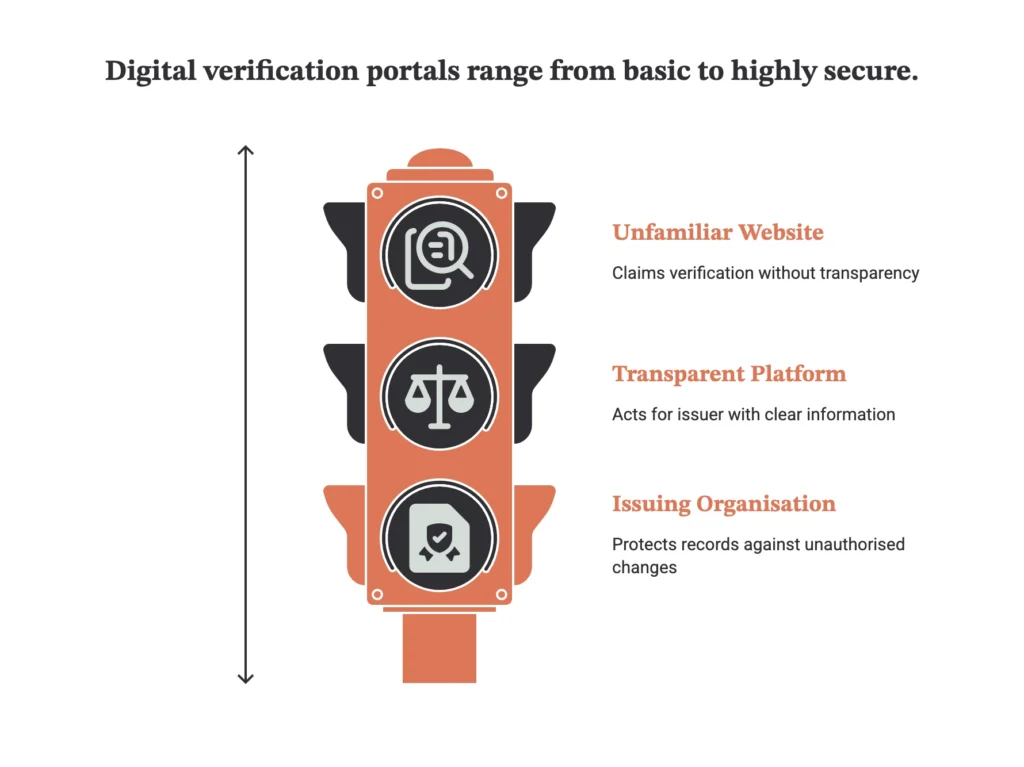
When evaluating a portal, it also helps to consider who runs it. A portal operated by the issuing organisation, or by a transparent and trusted platform acting for it, carries far more weight than an unfamiliar website that simply claims to verify certificates.
How Training Providers and Institutions Can Benefit
Digital verification is not only useful for employers. Educational institutions and training providers can also benefit. A secure verification system can help them:
- Protect their reputation
- Reduce fraudulent use of certificates
- Improve employer confidence
- Respond to verification requests more efficiently
- Maintain organised credential records
- Support international learners
- Strengthen trust in their certification programmes
It can also improve the experience for graduates. Instead of repeatedly requesting letters or confirmation documents, graduates may be able to share a verification link directly with employers. That saves time for the graduate, saves staff time for the institution, and gives employers an answer straight away.
For smaller academies in particular, a verification portal can signal professionalism. It shows that the institution stands behind its certificates and is willing to make them transparent.
What Employers Should Still Check
Even with a digital verification portal, employers should not stop their due diligence. Verification should be one part of a broader recruitment process. Employers should also consider:
- The candidate’s experience
- Relevant skills
- Professional references
- Interview performance
- Practical assessments
- The relevance of the qualification
- The reputation and legitimacy of the issuing organisation
A verified credential proves that a credential was issued. It does not, by itself, guarantee that the candidate is the right person for a particular job.
A Simple Verification Checklist
For employers and recruiters, a short routine can make verification consistent:
- Ask the candidate for the certificate number, verification link, or QR code.
- Open the issuer’s official verification page, ideally by typing the address yourself rather than relying only on a link you were sent.
- Compare the name, qualification, date, and status on the portal with the document presented.
- Note any mismatch, missing record, or unusual status, and ask the candidate to explain it.
- Confirm that the credential suits the role, and check any licensing or recognition requirements separately.
- Record the result of the check for your hiring file.
What Is a Digital Verification Portal?
Credential fraud can damage trust in education, professional training, and employment. A digital verification portal provides a practical way to strengthen that trust. By connecting credentials to official records, these systems can help employers confirm authenticity, identify inconsistencies, and reduce reliance on easily altered paper documents.
For professionals, digital verification makes it easier to prove their achievements. For employers, it provides a faster way to check qualifications. For educational and training institutions, it offers an opportunity to protect the credibility of their credentials.
However, digital verification is only one part of a trustworthy credential system. The real value comes from combining secure technology, transparent processes, credible issuing organisations, quality education, and responsible verification practices.
In a world where professional credentials are increasingly digital, the ability to verify what someone has achieved is becoming just as important as the achievement itself.
Leave a Reply