Professional certification has changed significantly over the past few years. Not long ago, earning a certification meant receiving a printed certificate, framing it or filing it away, and hoping it would never be questioned. If an employer wanted to confirm a qualification, someone had to contact the issuing organization, send a copy of the document, and wait for a reply that might take days or even weeks.
Today, professional credentials are becoming increasingly digital. Certification providers are moving toward online learning, remote assessments, and electronic certificates. This shift brings convenience, but it also raises an important question: how can anyone be sure that the person holding a credential is the person who actually earned it?
This is where secure ID systems are becoming essential. By connecting professional credentials to unique and verifiable identities, these systems help certification providers reduce fraud, speed up verification, and build greater trust between professionals and employers. Let’s look at how they work and why they matter.
What Is a Secure ID System?
A secure ID system is a technology-based system used to establish and verify the identity of an individual. In professional certification, this usually means assigning a unique identifier to each learner or credential holder and linking every stage of their certification journey to that identity.
Depending on the organization and the type of certification, a secure ID system may include:
- A unique candidate ID assigned at registration
- A digital credential ID printed on or attached to each certificate
- Secure login and account authentication
- Multi-factor authentication
- Identity document verification
- Biometric verification, where appropriate and lawful
- QR-based credential verification
The goal is simple: to make sure that the person earning and using a professional credential is correctly identified. The exact technology will vary, but the principle stays the same. Every credential should be traceable to a real, verified individual.

Why Does Identity Matter in Professional Certification?
Imagine someone completes an online certification programme and receives a certificate. How does the certification provider know that the person who sat the assessment was the same person who registered for the course? Without a reliable identity check, the answer is often, “We assume so.”
That assumption is one of the biggest challenges facing digital education. Secure identification systems address it by creating a clear chain that links the individual, their identity, their learning record, their assessment, and finally their credential. When each link in that chain is verified, the whole certification process becomes far more reliable.
1. Secure IDs Help Prevent Credential Fraud
Credential fraud is one of the most serious threats to professional certification. It can take many forms, including fake certificates, altered certificates, false claims about qualifications, sharing credentials with another person, and using someone else’s identity during an assessment.
A secure ID system reduces these risks. When a credential is tied to a unique identity, it becomes much harder for someone else to claim the same achievement. An employer can check that the credential genuinely belongs to the person presenting it, rather than relying on a document that could have been edited or copied. This protects honest professionals, who should not have to compete with people using fabricated qualifications, and it protects certification providers from damage to their reputation.
2. They Improve the Credential Verification Process
Traditional credential verification can be slow and frustrating. An employer often needs to contact the certification provider, supply a copy of the certificate, wait for a response, and then confirm the details manually. For organizations hiring at scale, this quickly becomes a burden.
A secure digital identity system simplifies the process. A professional can hold a unique credential ID that lets an employer verify the qualification through an official portal, sometimes in seconds. A QR code on a certificate, for example, can take the reader straight to a verification page that confirms the holder’s name, the credential, and its current status. Faster verification means faster hiring decisions and less administrative work for everyone involved.
3. They Strengthen Online Assessments
Online learning and remote examinations have become common across almost every industry. They give learners flexibility, but they also create a real challenge: how can a certification provider confirm the identity of the person taking the exam?
Secure ID systems help by adding identity checks at the right points in the assessment process. Depending on the programme, this may involve:
- Secure account authentication
- Identity document checks
- Multi-factor authentication
- Proctoring systems
- Other identity verification methods suited to the assessment
These measures help providers gain greater confidence that the correct person is completing the assessment. However, the methods used should always be proportionate, transparent, and compliant with applicable privacy and data-protection requirements. Learners should know what is being checked and why.
4. They Create a More Reliable Credential Record
Over a career, a professional may earn many qualifications from many different organizations. Without a reliable system, keeping track of these credentials becomes difficult, and proving them later can be even harder.
Secure ID systems can connect multiple achievements to a single verified identity. A professional might have a core professional certification, a trainer qualification, several specialized training certificates, and a record of continuing professional development. Linked to one verified profile, these achievements form an organized, trustworthy record of a person’s growth. This helps professionals present their full story, and it helps employers see the complete picture without chasing individual documents.
5. They Make International Verification Easier
Today’s workforce is global. Professionals may study in one country, work in another, and apply for opportunities somewhere else entirely. Employers are increasingly asked to evaluate credentials issued by organizations they have never encountered before, often in different languages and formats.
A secure digital ID and credential system makes this easier. Instead of relying on paper documents that are difficult to authenticate across borders, employers can check credentials through official digital systems. This supports international recruitment, cross-border employment, remote work, global professional networks, and international education.
It is important to be clear about one point, though. Secure identification does not automatically mean a qualification is recognized everywhere. Identity verification confirms who earned the credential. Credential recognition determines whether the credential is accepted for a particular purpose, such as a licence, a job, or a university place. These are separate issues, and both matter.
6. They Help Protect the Value of Professional Certifications
A certification is only valuable when people trust it. If employers regularly encounter fake certificates or cannot verify qualifications, confidence in the entire certification system can decline, and genuine holders pay the price.
Secure ID systems help protect the credibility of professional credentials by making it easy to confirm who earned the credential, which organization issued it, when it was issued, and whether it is currently valid. Each of these details closes a gap that fraudsters might otherwise exploit, and together they create a stronger level of trust between certification providers, professionals, and employers.
7. They Support Digital Credential Portfolios
As careers become increasingly digital, professionals are building online portfolios of their achievements. A secure ID system can connect a professional’s verified credentials in one place, ready to be shared with employers, clients, educational institutions, and professional organizations.
Instead of emailing a folder of scanned certificates, a professional can share a single verified digital profile. This is more convenient for the holder, and it gives the recipient a far better way to confirm authenticity. It also reduces the risk of outdated or altered copies circulating without the holder’s knowledge.
8. They Help Manage Credential Lifecycles
Not every certification lasts forever. Some are valid indefinitely, while others require renewal, continuing professional development, or periodic reassessment. Keeping track of these differences manually is time-consuming and prone to error.
Secure digital systems allow certification providers to manage the status of each credential clearly. A credential can be recorded as active, expired, renewed, suspended, or revoked. This helps employers understand whether a professional’s certification is currently valid, and it helps providers maintain accurate records. A certificate that was valid three years ago may not be valid today, and a live verification system makes that difference visible.
How Does Verification Work in Practice?
Consider a simple example. A learner registers for a certification programme and receives a unique candidate ID. Their identity is checked at registration, and they log in securely to complete their coursework and assessments. When they pass, the provider issues a digital certificate carrying a credential ID and a QR code.
Months later, the professional applies for a job. The employer scans the QR code, lands on the provider’s official verification page, and sees the holder’s name, the credential title, the issue date, and the current status. There is no need for emails, phone calls, or waiting. The employer gains confidence within moments, and the professional gains a smoother path to the opportunity.
This kind of process also leaves an audit trail. Providers can see when a credential was issued, when it was checked, and whether any unusual activity has occurred, which helps them detect misuse early.
Are Secure ID Systems the Same as Digital Credentials?
Not exactly. The two are closely related but serve different purposes. A secure ID system establishes and verifies the identity of the individual. A digital credential represents the qualification or achievement that the individual has earned.
Together, with a verification system that allows others to check the result, they form a complete credential ecosystem. The secure ID confirms who you are. The digital credential shows what you achieved. The verification system lets others confirm both. When these three pieces work together, professional certification becomes more secure and much easier to trust.
What About Privacy and Data Protection?
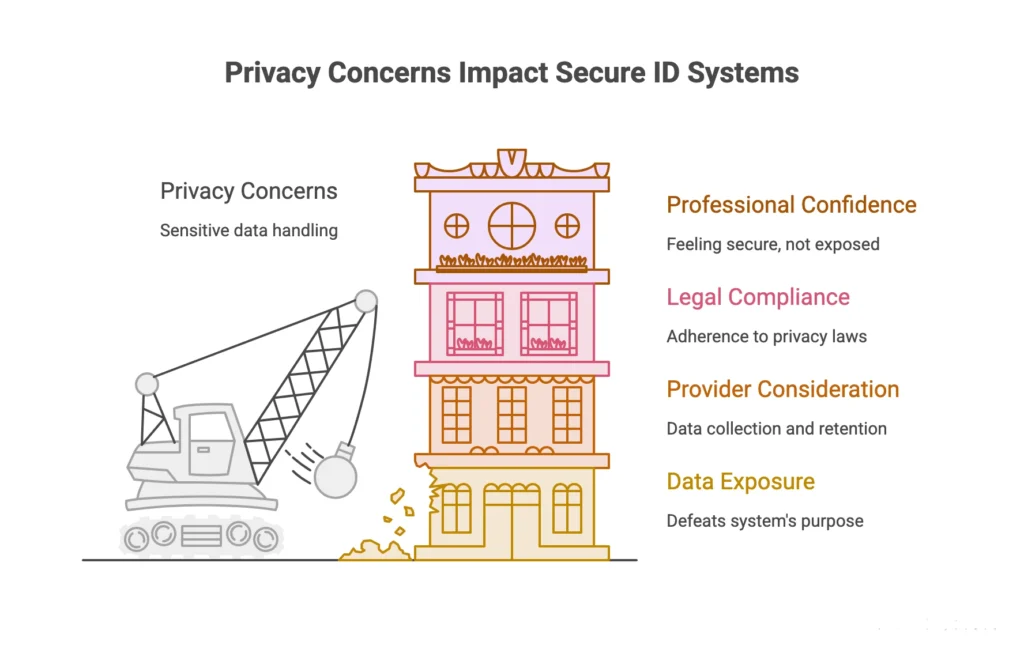
While secure ID systems offer many benefits, they also raise important questions about privacy. Identity information is sensitive, and it must be handled responsibly. A system that protects credentials but exposes personal data would defeat its own purpose.
Certification providers should carefully consider:
- What data they collect and why they need it
- How long they keep it
- Who can access it
- How it is protected against misuse or breach
- Whether individuals can control how their information is shared
Organizations should comply with applicable privacy and data-protection laws and use appropriate security measures. The aim is to create a system that is both secure and respectful of individuals’ privacy, so that professionals feel confident, not exposed, when they participate.
What Does This Mean for Professionals?
For professionals, secure ID systems can make it easier to manage and prove their qualifications. Instead of relying entirely on physical certificates that can be lost, damaged, or questioned, professionals can increasingly use digital systems to store credentials, share qualifications, verify achievements, demonstrate ongoing professional development, and apply for international opportunities.
That said, professionals should always check how their credentials are protected and how their personal information is used. Before enrolling with any certification provider, it is worth asking how identity data is stored, who can view it, and how a credential can be verified by a third party.
What Does This Mean for Certification Providers?
Certification providers have a real opportunity to improve the credibility and efficiency of their programmes by adopting secure identity and credential systems. A strong system can help organizations reduce credential fraud, improve the security of online assessments, simplify verification, protect professional records, support international learners, and build greater trust with employers.
However, technology must be introduced alongside clear policies and transparent processes. A secure system cannot compensate for poor assessment standards or weak certification practices. The most trustworthy certification systems will combine strong assessment standards, qualified professionals, secure identity verification, reliable credential records, transparent verification, and responsible data protection.
Looking ahead, professional certification is likely to become more digital, connected, and verification-focused. Professionals may carry their credentials digitally instead of relying on paper, employers may verify qualifications online in moments, and providers may use secure identity systems to connect learning, assessment, and credentials in one seamless process. Technology should always support quality, not replace it.
Leave a Reply