
When choosing a training programme, most people focus on the course content, duration, and fees. But there is another factor that often gets overlooked: who is actually delivering the training?
A trainer can have years of experience in an industry and still have limited knowledge of how to teach effectively. On the other hand, someone with a trainer certification may have formal knowledge of instructional methods but limited practical experience in the subject they teach.
This leads to an important question: What is the real difference between a certified trainer and a regular trainer?
The answer is more nuanced than simply saying one is better than the other. Both can be excellent trainers. The difference often comes down to their qualifications, teaching skills, experience, and the standards they follow. It’s a distinction that matters more than it might first appear, because the wrong choice can mean wasted time, wasted money, and a learning experience that never quite delivers what was promised.
Let’s take a closer look.
What Is a Certified Trainer?
A certified trainer is generally a professional who has completed a formal training or certification programme designed to develop their ability to teach, facilitate, or deliver learning programmes. This certification is usually awarded by a recognized body, an industry association, an academic institution, or a specialized training organization, and it typically signals that the individual has met a defined set of standards.
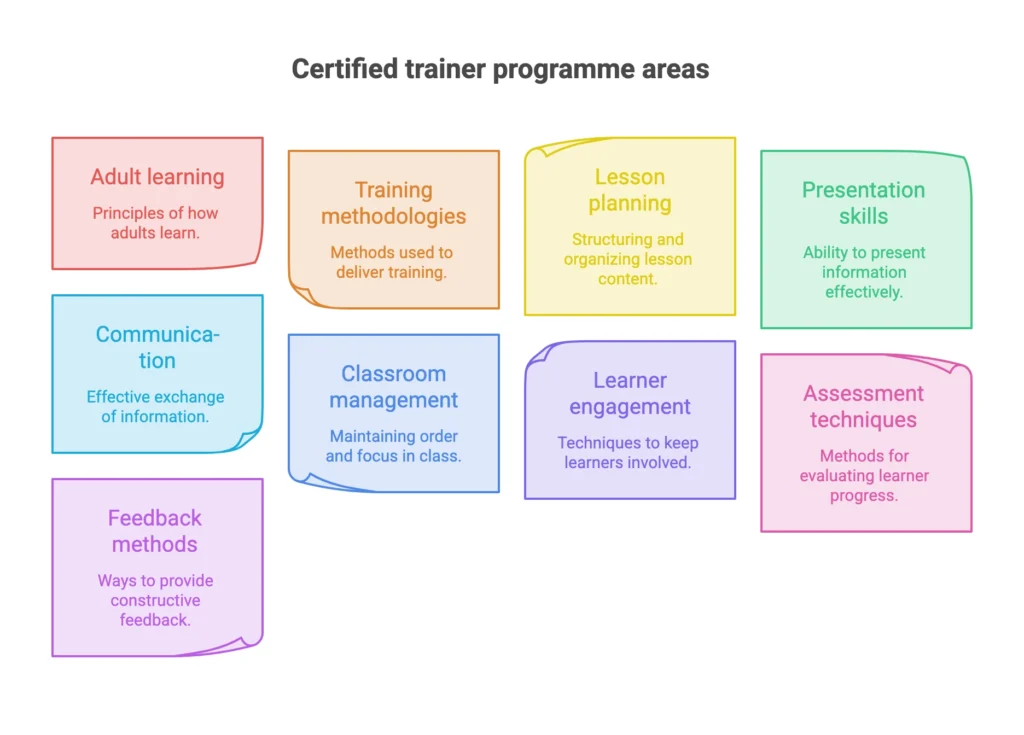
Depending on the organization providing the certification, the programme may cover areas such as:
- Adult learning principles
- Training methodologies
- Lesson planning
- Presentation skills
- Communication
- Classroom management
- Learner engagement
- Assessment techniques
- Feedback methods
Some certifications may also require the trainer to demonstrate their practical teaching abilities through an assessment or observed training session. This could involve delivering a mock session in front of an evaluator, submitting a training plan for review, or completing a supervised practicum where their performance is scored against a rubric.
However, the term “certified trainer” does not have one universal definition. Certification programmes vary enormously in rigor. Some require months of study, supervised practice, and renewal through continuing education. Others can be completed in a weekend with little more than a multiple-choice test at the end. The value of a certification, therefore, depends heavily on who issued it, what standards were used, and what the certification actually represents. A certificate from a well-regarded, internationally recognized body carries a very different weight than one from an organization with loose or unclear criteria.
What Is a Regular Trainer?
The term “regular trainer” is not an official professional category. It generally refers to someone who provides training without holding a formal trainer certification from an external organization.
This person may still have:
- Strong industry knowledge
- Years of professional experience
- Excellent communication skills
- Teaching experience
- Practical expertise
In fact, many highly respected trainers began their careers without formal trainer certification. They developed their teaching skills through experience, mentoring, and years of working with learners. Some rose through internal, on-the-job training programmes at their companies. Others learned by observing skilled colleagues, absorbing techniques over time, and refining their delivery through trial and error in front of real audiences.
It’s also worth noting that some “regular” trainers hold other kinds of credentials a professional license, an advanced degree, or an industry certification unrelated to teaching that speak to their subject-matter authority even if they’ve never taken a course specifically on instructional design. A senior engineer teaching a technical workshop, for instance, may have decades of hands-on credibility that no classroom-based teaching certificate could replicate.
The Key Differences
Let’s compare the two across several important areas.
1. Formal Training in Teaching Methods
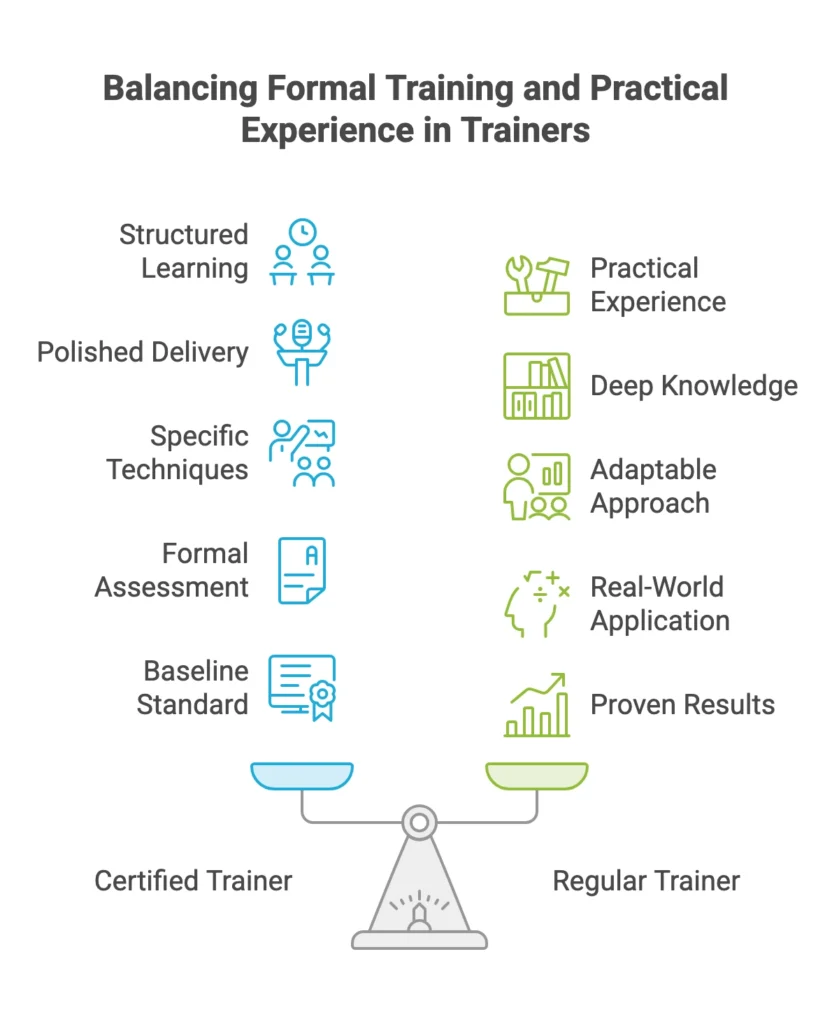
One of the biggest differences is the opportunity for structured learning about how people learn. A certified trainer may have studied adult learning theory, training design, facilitation techniques, assessment, and learning outcomes in a systematic way, often with feedback from instructors or mentors along the way.
A regular trainer may have developed these same skills through experience rather than formal training — picking up what works and what doesn’t by trial, observation, and repetition over years of practice.
Potential advantage: Certified Trainer
Formal training can provide a structured foundation for effective teaching, exposing trainers to concepts they might not otherwise encounter on the job. However, practical experience can be equally valuable when it is combined with good teaching ability and a willingness to keep learning and adapting.
2. Subject-Matter Expertise
A trainer can be excellent at teaching but lack deep knowledge of the subject. For example, someone may be a highly skilled trainer but have limited real-world experience in finance, healthcare, technology, or business. Their delivery might be polished, but their answers to nuanced, real-world questions may fall short.
A regular trainer with years of industry experience may have much deeper practical knowledge, having lived through the problems, edge cases, and mistakes that textbooks rarely capture.
Potential advantage: Depends on the individual
The ideal trainer combines both subject expertise and training ability. Neither certification nor years on the job guarantees this combination on its own.
3. Teaching and Communication Skills
Training is not simply about presenting information. A good trainer needs to:
- Explain concepts clearly
- Encourage participation
- Answer questions
- Adapt to different learners
- Handle challenging situations
- Give useful feedback
Certified trainer programmes often focus specifically on these skills, sometimes breaking them down into discrete, practicable techniques how to ask open-ended questions, how to manage a dominant voice in the room, how to read body language for signs of confusion.
However, experienced trainers can also develop these abilities through years of practice, especially if they’ve actively sought feedback and adjusted their approach along the way.
Potential advantage: Certified Trainer
Formal trainer development may provide a stronger foundation, particularly for professionals who are new to teaching and haven’t yet had the chance to learn these lessons the hard way.
4. Assessment and Evaluation
Professional training often requires more than simply attending a session. Students may need to demonstrate that they have actually learned something, whether through a test, a practical exercise, or an observed demonstration of a skill.
A certified trainer may have formal knowledge of designing assessments, measuring learning outcomes, evaluating performance, and providing constructive feedback in a way that is fair and consistent across learners.
This can be particularly important for technical or professional programmes, where certification bodies, regulators, or employers need confidence that competence has genuinely been achieved — not just that attendance was recorded.
Potential advantage: Certified Trainer
Structured knowledge of assessment can help ensure that learning is measured more effectively, and that the results actually reflect what participants can do afterward.
5. Professional Credibility
A credible trainer certification can provide an additional level of professional credibility. For institutions and organizations hiring trainers, certification may serve as evidence that the individual has completed a defined training programme and met a baseline standard.
However, certification should not be viewed as the only measure of competence. An experienced professional with a strong track record testimonials, repeat clients, measurable outcomes may be more effective than someone with a certificate but little practical experience.
Potential advantage: Depends on the trainer
The strongest evidence of credibility often comes from a combination of certification, experience, qualifications, and proven results, rather than any single factor in isolation.
Does a Certified Trainer Always Deliver Better Training?
No. This is one of the most important points to understand.
A certification is evidence that someone has completed a particular programme or met specific requirements. It does not guarantee that they are an outstanding trainer.
A certified trainer may still have poor communication, limited subject knowledge, weak presentation skills, or little practical experience. A piece of paper doesn’t automatically translate into an engaging classroom presence or up-to-date industry insight.
At the same time, an uncertified trainer may be highly experienced, extremely knowledgeable, a great communicator, and excellent at engaging learners all without ever having pursued a formal teaching credential.
The quality of the trainer depends on many factors, and no single label certified or not tells the whole story.
The Ideal Trainer Combines Both
The best trainers often combine three important qualities:
1. Subject Knowledge: They understand the topic they teach, deeply enough to handle unexpected questions and real-world scenarios.
2. Training Skills: They know how to communicate and facilitate learning, keeping a room engaged and making complex material accessible.
3. Practical Experience: They can connect theory with real-world situations, grounding lessons in examples that actually matter to learners.
When these three come together, learners often receive a much stronger educational experience. For example, a cybersecurity trainer with years of industry experience and formal trainer certification may be able to explain complex concepts while also connecting them to real workplace situations — walking through an actual breach scenario rather than a hypothetical one. That combination can be extremely valuable, and it’s often what separates a merely adequate course from a genuinely memorable one.
Why Does Trainer Certification Matter to Training Institutions?
For training institutions, having certified trainers can support a more structured approach to programme delivery. It may help institutions demonstrate that their trainers have received formal preparation in areas such as training delivery, assessment, learner engagement, and course planning.
This can be particularly useful for organizations seeking external accreditation, endorsement, or authorization, where a regulator or accrediting body wants assurance that instructors meet a consistent standard across the board not just that a few star performers happen to be good at their jobs.
However, institutions should always check the specific requirements of the relevant accrediting or authorizing organization. Some programmes may require trainers to have particular academic qualifications, professional experience, or industry credentials in addition to trainer certification, and a generic teaching certificate won’t necessarily satisfy those requirements on its own.
What Should Students Look for When Choosing a Trainer?
Instead of asking only “Is the trainer certified?”, ask a broader set of questions:
Does the trainer know the subject? Look at their qualifications and professional background, not just their teaching credentials.
Do they have teaching experience? Experience working with learners can be extremely valuable, regardless of whether it came through formal or informal channels.
Can they explain complex ideas clearly? Good trainers make difficult concepts easier to understand, often using analogies and step-by-step breakdowns.
Do they use practical examples? Real-world applications can make learning more meaningful and easier to retain.
How do they assess learning? A good training programme should have appropriate ways to measure progress, not just a certificate of attendance.
Do they provide feedback? Constructive feedback helps learners improve and identify their own blind spots.
Can their credentials be verified? Where certification is claimed, students should be able to understand who issued it and what it represents and be wary of vague or unverifiable claims.
Certified Trainer vs. Regular Trainer: A Quick Comparison
| Area | Certified Trainer | Regular Trainer |
| Formal trainer education | Usually available | May or may not have |
| Subject expertise | Depends on individual | Depends on individual |
| Teaching methodology | Often formally trained | May be developed through experience |
| Industry experience | Varies | Often varies |
| Assessment knowledge | May have formal training | Depends on experience |
| Professional credential | Has a trainer certification | May not have one |
| Practical teaching ability | Depends on experience | Depends on experience |
The table makes one thing clear: certification is only one part of the picture.
Leave a Reply