The way people prove their education, skills and professional achievements is changing. Not long ago, a paper certificate was usually enough to show that someone had completed a course or earned a qualification. Today, employers and institutions increasingly want faster and more reliable ways to check credentials.
Professionals now apply for jobs across borders, work remotely and build careers inside international companies. In that environment, being able to prove your qualifications quickly and securely can make a real difference. But what exactly are verifiable credentials, and why do they matter for your career in 2026? This guide explains the concept in plain language, shows where it helps, and is honest about where it does not.
What Are Globally Verifiable Credentials?
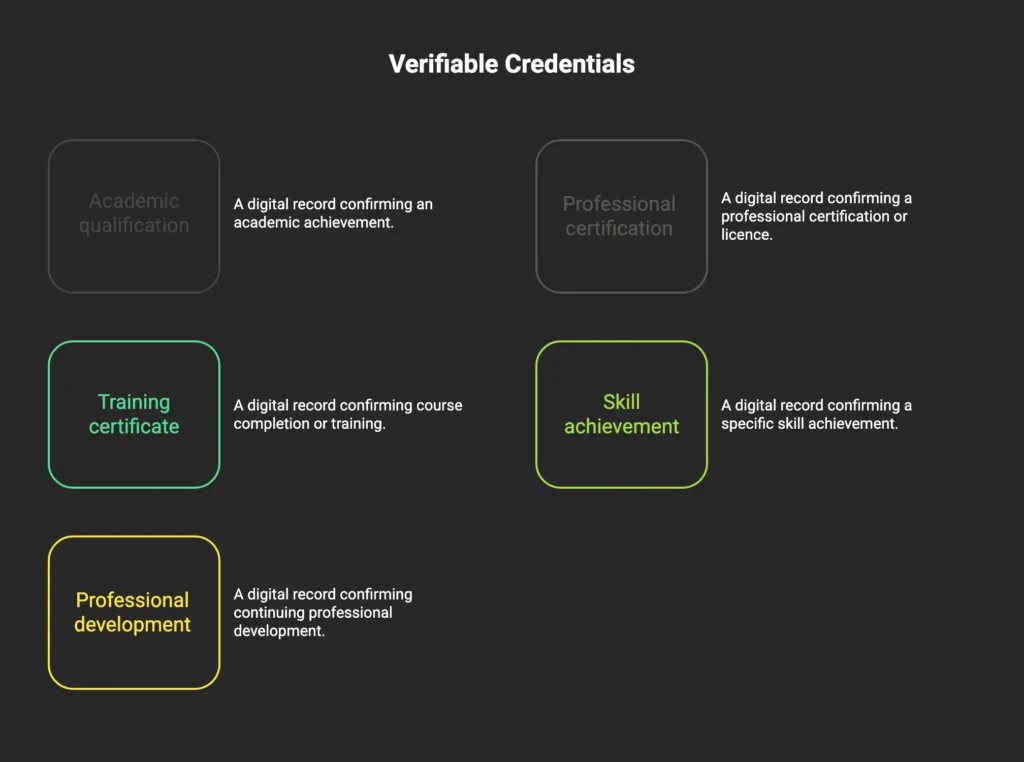
A verifiable credential is a digital record that can be checked to confirm that a particular organisation genuinely issued it. Instead of relying only on a printed certificate, an employer or institution can confirm the details through a digital system. A credential may represent:
- An academic qualification
- A professional certification or licence
- A training certificate or course completion
- A skill achievement
- Continuing professional development (CPD)
The technology varies. Some systems use QR codes, secure links or digital signatures, while others use open standards. The World Wide Web Consortium (W3C), for example, publishes the Verifiable Credentials Data Model, which describes a common way to express credentials that can be cryptographically checked. In education, the 1EdTech Open Badges standard and the Europass Digital Credentials framework follow a similar idea. The goal is simple: make it easier to prove that your achievement is genuine.
Why Is Verification Becoming More Important?
The global education and employment landscape has become increasingly digital. Professionals may study online, work remotely, earn qualifications from several countries, change careers and complete multiple short courses along the way. That creates a challenge for employers: how can they quickly decide whether a certificate is genuine?
Paper documents can be lost, damaged or hard to check. In some cases an employer has to contact the issuing institution manually, which can take days or weeks, especially across time zones and languages. Digital verification can make that process faster and more consistent.
Seven Ways Verifiable Credentials Can Help Your Career
1. They help employers verify your qualifications
Imagine applying to an international company that has never heard of the institutions behind your certificates. A verifiable digital credential lets the employer confirm who issued it, who received it, what was achieved, when it was issued and whether it is authentic. This reduces uncertainty during hiring. It does not guarantee you the job, but it makes your qualifications easier to evaluate.
2. They strengthen your professional profile
Your professional identity is no longer limited to your CV. It may include LinkedIn, portfolios, digital badges, online certificates and skills profiles. Instead of simply listing “Certified Project Management Professional”, you may be able to provide a credential that anyone can verify independently. That adds another layer of credibility.
3. They make international applications easier
Applicants abroad often struggle to prove their qualifications to people unfamiliar with their institution. A digital verification system lets a hiring manager check authenticity without relying entirely on paper. It is particularly useful for applications to international companies, remote roles, overseas training programmes and global educational institutions.
However, verification does not automatically mean recognition. A credential can be authentic and verifiable but still fail to meet the academic, professional or legal requirements of a particular country or organisation.
4. They reduce the risk of fake certificates
Credential fraud is a serious concern in both education and employment. When verification depends only on a physical document, fake certificates can be created or altered relatively easily. A verifiable credential lets an employer check that the stated organisation actually issued it, which protects both employers and genuine professionals.
5. They support lifelong learning
The modern career is rarely a straight line. People change industries, learn new technologies and pick up skills throughout their working lives. Many now build a portfolio of short courses, certifications, workshops and CPD rather than relying on one qualification for decades. Verifiable credentials help you keep a trustworthy digital record of that journey, so your development over time is clear.
6. They make hiring more efficient
Recruitment teams receive large numbers of applications, and checking every certificate by hand takes time. Digital verification lets employers confirm credentials more efficiently. For candidates, it can mean fewer repeated document submissions and less waiting for institutions to reply, which matters most in international recruitment.
7. They give you greater control over your achievements
Traditional certificates end up scattered across folders, drawers and old emails. Depending on the platform, digital credentials let you store them in one place, share verification links, add them to professional profiles and present achievements to employers when needed. That makes managing your career a little less stressful.
What Makes a Credential Truly Verifiable?
Not every digital certificate is a verifiable credential. A screenshot or a simple PDF can still be very hard to authenticate. A stronger system typically lets a third party confirm the issuing organisation, the recipient, the credential title, the date of issue, the current status (for example, whether it has been revoked) and the authenticity of the record itself.
As a practical test, try verifying your own certificate the way an employer would. Open the link or scan the code without logging in. If you cannot see independent confirmation from the issuer, the credential may be digital without being genuinely verifiable.
A Practical Example: How Verification Works in Practice
Consider an illustrative scenario. A project coordinator in Kerala applies for a remote role with a company in Europe. The recruiter does not know the training provider that issued her certificate, and the hiring deadline is close. Her certificate includes a QR code that opens a public record showing the issuer, her name, the course title, the issue date and a status of “valid”. The recruiter checks it in under a minute and moves her application forward.
Now compare that with a scanned PDF and a request to “call the institute”. The recruiter may wait days for a reply, or simply move on to the next candidate. The qualification is identical in both cases. The difference is how easily it can be proven, and that is exactly the gap verifiable credentials aim to close. Note that the QR code only settled authenticity. Whether the employer accepted the course as relevant experience was still its own decision.
Verifiable Does Not Always Mean “Globally Recognised”
This distinction matters. A credential may be verifiable anywhere in the world without being recognised everywhere. A training certificate can be authentic and digitally verifiable, yet an employer may still have its own hiring requirements. Regulated professions such as medicine, law, engineering and teaching often require specific licences or government-recognised qualifications.
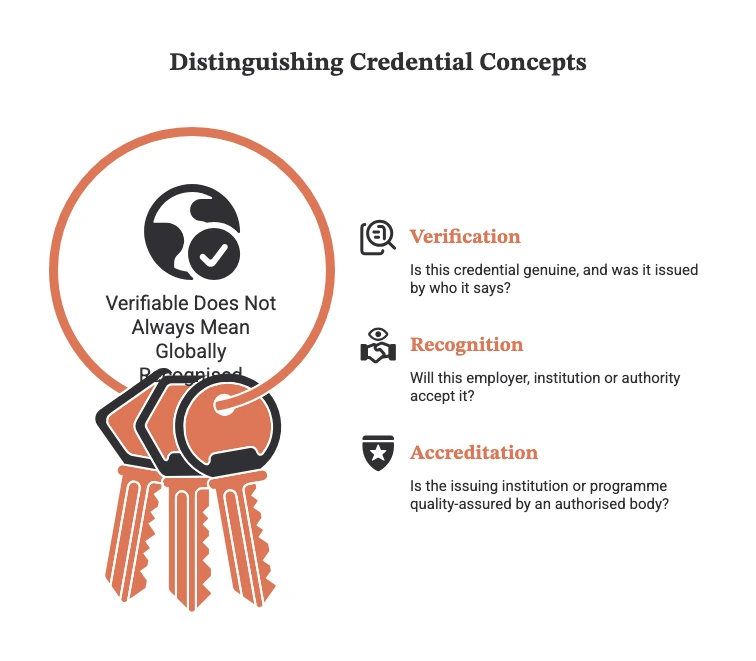
Recognition of higher education qualifications between countries is handled through legal and institutional frameworks, such as the UNESCO Global Convention on the Recognition of Qualifications concerning Higher Education and national information centres in the ENIC-NARIC network. A verifiable credential does not replace those processes. Keep these three concepts apart:
| Concept | What it answers | Example |
| Verification | Is this credential genuine, and was it issued by who it says? | An employer scans a QR code and sees the issuer, recipient, title and date. |
| Recognition | Will this employer, institution or authority accept it? | A university decides whether to count the credential towards admission. |
| Accreditation | Is the issuing institution or programme quality-assured by an authorised body? | A programme reviewed against published standards by a recognised accreditor. |
These concepts are related but not interchangeable. A credential can be verified without being recognised, and a programme can be accredited without every employer accepting it.
How Can Professionals Prepare for the Future?
If you are building a career in 2026 and beyond, keep an organised record of your achievements: academic qualifications, professional certifications, training programmes, CPD, industry awards and skill-based credentials. When choosing a course or certification, ask whether the issuer provides a reliable verification system, and research the organisation itself. A short checklist helps:
- Who issues the credential?
- Can it be independently verified, without a login or a phone call?
- What does the credential actually represent: attendance, assessment or competence?
- Is the issuing organisation credible, and is it quality-assured or accredited by a recognised body?
- Is the programme relevant to your career goals?
- Does your target employer, industry or regulator accept it?
These questions can help you avoid spending time and money on credentials that carry little professional value.
It also pays to review your records once a year. Confirm that every verification link still works, download a backup of each certificate, and note renewal or expiry dates for licences and CPD cycles. Credentials that cannot be checked later lose much of their value.
Red flags to watch for
- Promises of instant qualifications with no assessment
- Vague or unnamed accrediting bodies, or accreditors that cannot themselves be verified
- No way to check a certificate other than contacting the seller
- Claims of “worldwide recognition” without naming who recognises it
What Employers and Institutions Gain
Verification is not only a benefit for candidates. Employers reduce the time spent chasing documents and lower the risk of hiring decisions built on false information. Universities and training bodies can process applications from overseas more quickly when they can confirm prior learning at the source. Issuers themselves benefit too, because a credential that can be checked protects their name from misuse.
For smaller organisations, this can be a real advantage. A small business without a dedicated compliance team can still make confident decisions if checking a credential takes a minute instead of a week. The same applies to professional associations that need to confirm membership or CPD records before renewing a licence or granting a status.
The Future of Professional Credentials
Education and employment are becoming more digital. As people learn from different institutions and work across borders, the ability to verify qualifications quickly will matter more. Employers want reliable information, institutions want trustworthy records, and professionals want a simple way to show what they have achieved. Verifiable credentials can help connect those needs.
Looking ahead, expect more employers to ask for a verification link at application stage, and more learners to carry a single digital wallet of achievements from school through to senior roles. Standards will keep maturing, but the basic questions will stay the same: who issued this, can I check it, and does it mean what it claims to mean?
Technology alone will not decide the value of a credential, though. That still comes from the quality of the education, the credibility of the issuer, and the skills and knowledge the credential represents.
In short, a verifiable credential is only as valuable as the achievement and the organisation behind it. Focus on meaningful qualifications from credible institutions and choose credentials that genuinely reflect your skills. The future of careers will not simply be about what you say you have achieved. It will increasingly be about how easily you can prove it.
Leave a Reply